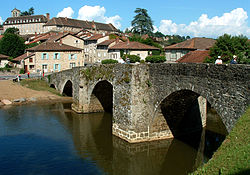
Solignac (French pronunciation: [sɔliɲak]; Occitan: Solenhac) is a commune in the Haute-Vienne department in the Nouvelle-Aquitaine region in west-central France.

1. Geography

The village lies on the right bank of the Briance, which flows westward through the commune. It contains the former Abbey of Solignac, part of the Benedictine order; founded in 631 and rebuilt several times, the current buildings date from the 17th century. Suppressed during the French Revolution and used as a porcelain factory until 1931, the former Abbey church is known as an exceptional example of Romanesque architecture and has been designated a National Historic Monument. On 1 August 2021 the community of Benedictine monks returned to the abbey and will be an active religious site once again. Solignac-Le Vigen station has rail connections to Brive-la-Gaillarde and Limoges. Inhabitants are known as Solignacois in French.

1. Personalities

St Ramaclus, 7th-century monk who was the first abbot at Solignac Abbey. Joseph Brousseau, French architect probably born at Solignac around 1733 and died at Sées in the Orne on 5 February 1797. Georges d'Aubusson de La Feuillade (1609-1697), later Bishop of Embrun and Bishop of Metz was a member and later Abbot of Solignac Abbey, from 1639 to 1649;

1. See also

Communes of the Haute-Vienne department

1. References


1. External links

COMMUNE SOLIGNAC PHOTO GALLERY

Nearby Places View Menu
Location Image
168 m

Solignac Abbey

Solignac Abbey, or the Abbey of Saint Peter and Saint Paul of Solignac, is an abbey in Solignac, near Limoges, in Haute-Vienne. It was founded around 631 AD by Saint Eligius (Éloi). The present buildings date to the 12th century, but have been modified many times since then. The abbey was dissolved during the French Revolution and the buildings were put to new uses, including a prison, boarding school, porcelain factory and seminary. As of 2021 there were plans to restore it back to its original function as a monastery.
Location Image
756 m

Solignac–Le Vigen station

Solignac–Le Vigen is a railway station serving Solignac and Le Vigen, Nouvelle-Aquitaine, France. The station opened on 1 July 1893 and is located on the Orléans–Montauban railway line. The station is served by TER (local) services operated by SNCF.
Location Image
1.1 km

Le Vigen

Le Vigen (French pronunciation: [lə viʒɑ̃]; Occitan: Lo Vijan) is a commune in the Haute-Vienne department in the Nouvelle-Aquitaine region in west-central France.
Location Image
1.9 km

Parc du Reynou

The Parc zoo du Reynou (Occitan: Parc Zoologic Reynou) is a zoological park situated in the Haute-Vienne region, in the commune of Le Vigen. The park covers more than 60 hectares and houses more than 600 animals from over 130 different species. It opened on July 1, 1997 and presents a wide variety of species ranging from pygmy marmosets, the smallest monkey in the world, to Rothschild's giraffes, as well as many other species of wild animals and birds. It has been designed to allow each animal to reside in a close approximation of its natural environment. The animals are divided geographically into two African plains, two Asian plains, a South American sector, an Australian sector and a mini-farm. The park is organised around the Haviland family château and atypical rock gardens. The gardens were created by André Laurent at the end of the 19th century, at the request of Charles-Édouard Haviland. Many of the plant species are rare for the region, including giant redwoods and American oaks. In 2013, the park welcomed snow leopards, bharals and Visayan warty pigs. In 2016, the Parc zoo du Reynou increased the number of species on show with the construction of a small farm at the heart of the zoo featuring the local bread of cul-noir pig. An island was built in the river to accommodate red pandas. Many other species have also joined the zoo in recent years, including kinkajous, South American Tapirs and onagers. The lodges opened in 2016 and are available all year round. In 2017, the park celebrated its 20th anniversary.