
Brunswick is an inner-city area of south Manchester, England, south of Manchester Piccadilly railway station and north of Manchester Royal Infirmary, between Manchester city centre to the north, Ardwick to the east, and Chorlton-on-Medlock to the south and west. It was historically part of Chorlton-on-Medlock and acquired its name from Brunswick Street which runs through it. Its western edge is dominated by campus buildings of Manchester University, east of Oxford Road, and its northern edge by the Mancunian Way. The campus buildings have all been built since 1957, and several large new buildings have appeared since the inauguration of the present University in 2004, such as University Place on the site of the former Mathematics Building.

The local Church of England church is Christ Church, Brunswick. There was formerly an Anglican church of St Paul in Brunswick Street (corner of Higher Temple Street). St Paul's Church was built to a design by Clegg & Knowles in 1862; in 1878 it was lengthened and restored by Horton & Bridgeford.

Nearby Places View Menu
Location Image
0 m

University Dental Hospital of Manchester
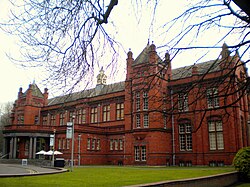
The University Dental Hospital of Manchester is a dental facility in Manchester, England. It is managed by Manchester University NHS Foundation Trust.
Location Image
48 m

The Whitworth

The Whitworth is an art gallery in Manchester, England, containing over 60,000 items in its collection. The gallery is located in Whitworth Park and is part of the University of Manchester. In 2015, the Whitworth reopened after it was transformed by a £15 million capital redevelopment that doubled its exhibition spaces, restored period features and opened itself up to its surrounding park. The gallery received more than 440,000 visitors in its first year and was awarded the Art Fund's Museum of the Year prize in 2015.
Location Image
93 m

Manchester Institute of Innovation Research

Manchester Institute of Innovation Research (MIoIR) is a research institute based in Alliance Manchester Business School at the University of Manchester, UK. MIoIR is a centre of excellence in the fields of innovation studies, technology management and innovation management, science policy, technology policy, innovation policy and regional innovation, the study of emerging technologies (or em tech), responsible research and innovation, and research into socio-technical transitions with a focus on sustainability and digital transitions. MIoIR has also been known for research on service innovation and in particular the definition and early exploration of the concept of knowledge-intensive business services, through the work of scholars such as Ian Miles and Bruce Tether. The Institute consists of a group of internationally renowned scholars and experts, with more than 50 full members, approximately 30 PhD researchers, and a range of associated academics. Since the 1970s the institute and its predecessor bodies have contributed to the national and international debate about science policy and innovation (as noted in connection with UK debates by Agar) and helped develop the field of research evaluation and formulating the now widely used concept of behavioural additionality. The Institute is currently housed in the newly refurbished Alliance Manchester Business School building on the corner of Oxford Road and Booth Street West, Manchester. For many of its earlier years it was based with the now-demolished Mathematics Tower of the University of Manchester. A number of the current members of MIoIR are also co-investigators of, or otherwise affiliated with, the ESRC-funded Productivity Institute, a national virtual institute with its headquarters at Manchester.
Location Image
137 m

Whitworth Park

Whitworth Park is a public park in south Manchester, England, and the location of the Whitworth Art Gallery. To the north are the University of Manchester's student residences known as "Toblerones". It was historically in Chorlton on Medlock but is now included in the Moss Side ward. The park, of some 18 acres (7.3 ha) opposite Manchester Royal Infirmary, was opened in 1890 on land known as Potters Field. The park was leased to the Corporation of Manchester by the Whitworth Trustees in October 1904 on a 1000-year lease for a nominal annual rent of £10. A statue of King Edward VII by John Cassidy on the east side, unveiled in 1913, commemorates the royal visit when the new Royal Infirmary was opened in 1909. The bronze statue, mounted on a square, stepped granite plinth and pedestal, is a grade II listed structure. A sign in the park referring to a meteor that fell on the night of Friday 13 February 2015, and was lost, is a hoax commemorative plaque by artist Cornelia Parker which actually refers to 'Blakeian Abstract', one of her artworks which was specifically created for the Whitworth Art Gallery's February 2015 opening.