

 English
 Français

Nantwich Bridge
Nantwich Bridge (also known as the Welsh Row Bridge and formerly the Welsh Bridge) is a stone bridge carrying Welsh Row over the River Weaver in the town of Nantwich, Cheshire, England. The existing bridge replaces a 17th-century stone bridge; it dates from 1803 and is listed at grade II. An earlier timber bridge known as the Wich Bridge is first mentioned at the end of the 14th century; it is described as having a chapel and shops on it. Nantwich lay on the main London–Chester road, an important transport route, and the bridge was heavily used for trade and military purposes from the medieval era until the 19th century.
Nearby Places View Menu

81 m
Regent and Warwick House
Regent House and Warwick House together form a large timber-framed building, probably dating from the late 16th century, in Nantwich, Cheshire, England. Regent House occupies numbers 12 and 14, and Warwick House numbers 16 and 18a, on the west side of the High Street (at SJ6502652380 and SJ6504252377); Regent House occupies a bend in the street which reflects the town's Norman castle. The building was probably constructed shortly after the fire of 1583. Regent House and Warwick House are listed separately at grade II.
High Street was the home of the wealthiest townspeople in the 1580s, and the houses dating from the rebuilding form the finest examples of post-fire architecture in the town. The modern street still contains many other good examples of Elizabethan timber-framed buildings, all of which date from after the fire; these include the Queen's Aid House, number 46 and the grade-I-listed Crown Inn.

90 m
Widows' Almshouses, Nantwich
The Widows' Almshouses, also known as the Wilbraham or Wilbraham's Almshouses and as the Widows' Hospital, are former almshouses for six widows in Nantwich, Cheshire, England. They are located at numbers 26–30 on the north side of Welsh Row, on the junction with Second Wood Street (at SJ6486452420). The almshouses were founded by Roger Wilbraham in 1676–7 in memory of his deceased wife in three existing cottages built in 1637; they were the earliest almshouses in the town for women. In 1705, Wilbraham also founded the Old Maids' Almshouse for two old maids in a separate building (now demolished) on Welsh Row. They remained in use as almshouses until the 1930s. The timber-framed Widows' Almshouses building, which is listed at grade II, has subsequently been used as a café, public house, night club, restaurant, wine bar and hotel.
Nikolaus Pevsner considers Welsh Row "the best street of Nantwich". The street has many listed buildings and is known for its mixture of architectural styles, including other black-and-white cottages, Georgian town houses such as Townwell House and number 83, and Victorian buildings such as the former Grammar School, Primitive Methodist Chapel and Savings Bank. Two other former almshouses remain on Welsh Row: the Wilbraham's Almshouses were founded in 1613 by Wilbraham's ancestor Sir Roger Wilbraham, and the Tollemache Almshouses were built in 1870 to replace these by John Tollemache, a descendant of Sir Roger Wilbraham.
103 m
20 High Street, Nantwich
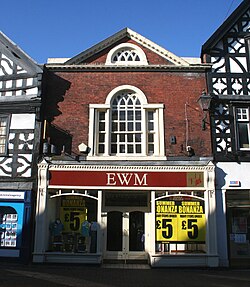
20 High Street is a grade-II-listed Georgian building in Nantwich, Cheshire, England, which dates from the late 18th century. It stands on the west side of the High Street (at SJ6505352367). In the 18th century, the building was used as an inn and a venue for cock-fighting; it later became a private house and subsequently a shop. The site is believed to have been near the town's Norman castle.
The town contains many other Georgian listed buildings, most of which were built as town houses; good examples include 9 Mill Street, Dysart Buildings on Monks Lane, and Townwell House and number 83 on Welsh Row. Number 20 is one of the few examples on the High Street, which is known for its many Elizabethan timber-framed buildings, including Regent and Warwick House and the grade-I-listed Crown Inn, which both stand near number 20.
120 m
Nantwich Castle
Nantwich Castle was a Norman castle in Nantwich, Cheshire, England, built before 1180 to guard a ford across the River Weaver. The castle is first documented in 1288. It was last recorded in 1462, and was in ruins by 1485. No trace now remains above ground; excavations in 1978 near the Crown Inn uncovered terracing and two ditches, one or both of which possibly formed the castle's bailey.