

 English
 Français

The Manchester Opera House est une salle d'opéra anglaise qui se situe Quay Street à Manchester en Angleterre. Doté de 1 920 places assises, il accueille en tournée des comédies musicales, des ballets, des concerts et à Noël un spectacle de pantomime. Elle est monument classé de Grade II.
Lieux à Proximité Voir Menu

1 m
Manchester Opera House
The Opera House in Quay Street, Manchester, England, is a 1,920-seater commercial touring theatre that plays host to touring musicals, ballet, concerts and a Christmas pantomime. It is a Grade II listed building and one of the main theatres in Manchester. The Opera House and its sister theatre the Palace Theatre on Oxford Street are operated by the same parent company, Ambassador Theatre Group.

58 m
County Court, Manchester
The County Court is a Georgian townhouse on Quay Street in Manchester, England, that served as the city's county court from 1878 to 1990. It was the home of the politician and reformer Richard Cobden, and later the site of Owens College, the forerunner of the University of Manchester. In origin, it is a townhouse of the 1770s, described as "the best preserved Georgian house in the [city] centre". The house is built of brick and has a late 19th-century doorcase. It was designated a Grade II* listed building on 3 October 1974. The interior is not original.

61 m
Quay Street
Quay Street is a street in Manchester city centre in Greater Manchester, England. The street, designated the A34, continues Peter Street westwards towards the River Irwell and Salford. It is the northern boundary of Spinningfields, the city's business district and Castlefield, the historical area of the city, lies to the south. Quay Street was created in the 18th century for access to a quay on the river and is lined by several listed buildings.
Edward Byrom built a quay on the River Irwell in the 1730s and the street was built to link it to Deansgate which was then known as Aldport Lane. In 1794 it was extended eastwards to Mosley Street. Richard Cobden's red brick townhouse, built in the Georgian style was the first home of Owens College and afterwards Manchester County Court. It is a Grade II* listed building. In the 1840s, Harry Stokes ran a beerhouse at numbers 3–5 Quay Street. The Hospital for Skin Diseases was in Quay Street. The Opera House, formerly the New Theatre, was built in 1912 by Albert Richardson and Charles Lovett Gill with Farquarson in the classical style.
Architect Joseph Sunlight built the Grade II listed Sunlight House. He had planned to build the Quay Street Tower, a 360-foot (110 m) high-rise Art Deco building behind Sunlight House but was refused planning permission. Had it been built, it would have been not only Manchester's tallest building, but the tallest in Europe.
The street is known for Granada Studios, the UK's first purpose-built television studios and home to Granada Television. The building was designed by architect Ralph Tubbs and was an early example of a building constructed using the curtain wall method. In September 2010, the red 'Granada TV' sign was removed from the building as it was extensively corroded.
64 m
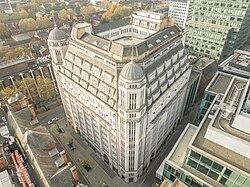
Sunlight House
Sunlight House is a Grade II listed building in the Art Deco style on Quay Street in Manchester, England. Completed in 1932 for Joseph Sunlight, at 14 storeys it was the tallest building in Manchester, and the top floors of turrets and multiple dormer windows and mansard roofs create a distinctive skyline.
115 m
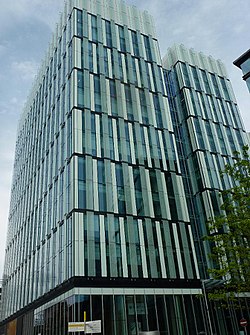
3 Hardman Street
3 Hardman Street is a 16-storey high-rise building in Spinningfields, Manchester, England. At 75 m (246 ft), as of 2023 it is the third-tallest building in the Spinningfields area (after 1 Spinningfields and the Manchester Civil Justice Centre) and the joint 36th-tallest building in Greater Manchester.
Its nearest airport is Manchester Airport, located 8.7 miles away; the nearest train station is Deansgate, located 0.4 miles away; and the nearest bus stop is Cheapside (Stop CO), which is located 0.3 miles away.