

 English
 Français
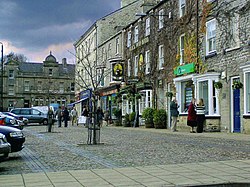
Leyburn
Leyburn est une petite ville et une paroisse civile du Yorkshire du Nord, en Angleterre. Elle est située dans le Wensleydale, la vallée de la rivière Ure. Administrativement, elle dépend du district du Richmondshire. Au moment du recensement de 2011, elle comptait 2 183 habitants.
Nearby Places View Menu

144 m
St Matthew's Church, Leyburn
The church of St Matthew Leyburn (also known as The Parish Church of St Matthew, Leyburn) is the parish church for Leyburn in North Yorkshire, England. It is just to the south-east of Leyburn town centre and on the northern side of the A684 road. The parish is relatively new (being raised in 1956) and the church itself was built in 1868 after many years of parishioners having to travel to nearby Wensley (1-mile (1.6 km) to the west) to worship.
In 2017, permission was granted to allow the parish to remove the pews and enhance car parking around the site, despite some objections to the overall plan. The church celebrated its 150-year anniversary in 2018.

145 m
Leyburn Town Hall
Leyburn Town Hall is a municipal building in the Market Place, Leyburn, North Yorkshire, England. The structure, which is used for retail purposes and as an events venue, is a grade II listed building.

148 m
Leyburn
Leyburn is a market town and civil parish in North Yorkshire, England, sitting above the northern bank of the River Ure in Wensleydale. Historically in the North Riding of Yorkshire, the name was derived from 'Ley' or 'Le' (clearing), and 'burn' (stream), meaning clearing by the stream. Leyburn had a population of 1,844 at the 2001 census increasing to 2,183 at the 2011 Census. The estimated population in 2015 was 2,190.

196 m
Leyburn Hall
Leyburn Hall is a historic building in Leyburn, a town in North Yorkshire, in England.
The hall was built in about 1750, for John Yarker, although it is possible that it may retain some material from a 17th century forerunner. A Catholic chapel is supposed to have stood nearby, and it is possible that this may have been in the west pavilion. The house was grade II* listed in 1967.
The house is roughcast, and has stone dressings, a stone slate roof, two storeys and an E-shaped plan. The south front has a central five-bay block on a plinth, with rusticated quoins, a string course, a moulded cornice, and a blind parapet. The windows are sashes with moulded surrounds, the central ground floor window with an eared architrave and a cornice on consoles. The block is flanked by single-bay links containing openings with quoined surrounds. At the ends are pedimented pavilions with quoins, each containing a full-height round-arched opening with a moulded surround, and containing a tripartite window with Doric half-columns, and a Diocletian window above. On the top is a wrought iron weathervane. The north front has seven bays, a central Doric portico, and Venetian windows. Inside, there is a grand staircase hall with a plasterwork ceiling which may have been designed by Giuseppe Cortese. The Morning Room has early panelling, and both it and the Drawing Room have high-quality doorcases and cornices.

319 m
St Peter and St Paul's Church, Leyburn
St Peter and St Paul's Church is a Catholic church in Leyburn, a town in North Yorkshire, in England.
The church and adjoining presbytery and stable with schoolroom above were built in 1835 by Chapleo and Sons. The work cost about £2,000, and the building is in the Gothick style. The school closed in the early 1870s, although a new Catholic school was built just to the south in 1895. The sanctuary was reordered in the late 20th century, and the east window was restored in 2010. The church and presbytery were separately grade II listed in 1986, and the church was upgraded to grade II* in 2016.
The church is built of sandstone on a plinth, with limestone dressings, rusticated quoins, an eaves string course, and a stone slate roof. The southeast gable has moulded coping and a Latin cross, and the other gable has a bellcote and a ball finial. The doorway and the windows have chamfered surrounds, round-arched heads and hood moulds, and the windows have Y-tracery. Inside the church are box pews and a west gallery.
The presbytery is built of limestone with sandstone dressings, quoins, and a Welsh slate roof with a coped gable. It has two storeys and three bays, and a rear extension. The central doorway has a semicircular fanlight, and is set in a round-headed arch with imposts and a keystone. At the rear of the presbytery is the former stable and schoolroom containing a basket-arched cart opening. External steps lead up to the schoolroom. The boundary is enclosed by stone walls, and the entrance drive to the church has cast iron railings and a gate.