
1er Mai est une station multimodale de la ligne 1 du métro d'Alger.

1. Caractéristiques

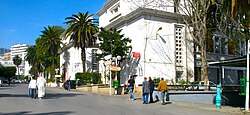
La station 1er Maoi est une station souterraine située à proximité de la station de bus du même nom au sud de la place de la Concorde et à l'est de la place El Mokrani.

1. Histoire

La station est inaugurée le 31 octobre 2011 et ouverte le lendemain 1er novembre lors de la mise en service de la première section de la ligne 1 du métro d'Alger.

1. Sorties

Sortie n°1 : place de la Concorde Sortie n°2 : station de bus ETUSA Sortie n°3 : ministère de la jeunesse et des sports Sortie n°4 : rue Mohamed Chekired Sortie n°5 : rue Mohamed Belouizdad Sortie n°6 : rue colonel Ali Mellah (parc du '1er Mai' )

1. Correspondances

La station est desservie par les bus du réseau ETUSA : Lignes 07, 10, 14, 15, 16, 19, 48, 65, 79, 88, 89, 90, 99.

1. À proximité

La place de la Concorde (anciennement place du 1er mai, Champ de Manœuvres) L'hôpital Mustapha Pacha Le centre Pierre et Marie Curie La Maison du Peuple Le quartier Belouizdad (anciennement Belcourt) La rue Hassiba Ben Bouali La piscine olympique du 1er mai Le marché Ali Mellah

1. Galerie photos


1. Voir aussi


1. = Articles connexes =

Métro d'Alger

1. = Liens externes =

Site du métro d'Alger Ligne 1 du métro d'Alger sur Structurae

1. Notes et références

Portail du métro Portail d'Alger

Nearby Places View Menu
Location Image
250 m

Mustapha Pacha hospital

Centre Hospitalo-Universitair Mustapha Pacha (French: Centre Hospitalo-Universitaire Mustapha d'Alge) was founded in 1854 in the town of Moustapha (now Sidi M'Hamed) and is the largest hospital in Algeria. This hospital center is one of 14 Centre Hospitalo-Universitair under the Algerian Ministry of Health, Population and Hospital Reform.
Location Image
449 m

Sidi M'Hamed

Sidi M'Hamed (Arabic: سيدي أمحمد) is a municipality in Algiers Province, Algeria; formerly known as Mustapha. It is the seat of the district of the same name. Its municipal code is 1602 and postal code is 16014 and it has a population of 90,455 as of the 1998 census, which gives it 15 seats in the PMA. The municipality is named after the founder of the Rahmaniyya Sufi order Sidi M'hamed Bou Qobrine.
Location Image
765 m

Archdiocese of Algiers

The Archdiocese of Algiers (Latin: Archidioecesis Algeriensis, French: Archidiocèse de Alger) is the metropolitan see for the ecclesiastical province of Algiers in Algeria.
Location Image
782 m

Cathédrale du Sacré-Cœur d'Alger

Cathédrale du Sacré-Cœur d'Alger (Sacred Heart Cathedral of Algiers) is a Roman Catholic church located in Algiers, Algeria. Completed in 1956, it became the new cathedral in the capital after the Cathedral of Saint Philip of Algiers reconverted into a Muslim Ketchaoua Mosque. The Cathédrale du Sacré-Cœur d'Alger is the cathedral church of the Archdiocese of Algiers. Construction of the church began after a wish of Bishop Leynaud in 1944. It was elevated to a cathedral in December 1962 and consecrated in 1963. The designers of the building, Paul Herbé and Jean Le Couteur, along with engineer René Sarger, were inspired by the Gospel of John. Its nave measures 52 metres (171 feet) long and 35 metres (115 feet) wide. The church is noted for its central tower. At the entrance to the nave there are small organs offered by the parish of Boufarik opposite which is a mosaic. The mural dates to 324, from the first Roman basilica of Castellum Tingitanum (Chlef). The altar is made of Carrara marble, and houses the relics of numerous African saints.
Location Image
796 m

Bardo National Museum (Algiers)

The Bardo National Museum of Prehistory and Ethnography (Arabic: المتحف الوطني باردو, El-mathaf El-ouatani Bardo, French: Musée National de Préhistoire et d'Ethnographie du Bardo) is a national museum located in Algiers, Algeria. The edifice is a former Moorish villa. It was opened as a museum in 1927. Nothing specific is known about this residence, formerly in the countryside and now encompassed in the modern city. H. Klein tells us that the palace was built in the eighteenth century and that it would have been the property of Prince Omar before the French conquest. A document, in the form of a drawing signed by Captain Longuemare, specifies that it was Mustapha ben Omar who was a very rich Tunisian. In 1926, the Bardo Palace was ceded to the Domains by Mrs Frémont, sister and heiress of Pierre Joret.