

 English
 Français

Naburn Hospital was a mental health facility in Naburn, North Yorkshire, England.
Nearby Places View Menu

779 m
Old St Andrew's Church, Bishopthorpe
Old St Andrew's Church is a ruined building in Bishopthorpe, a village south of York in England.
The first church on the site was built in the early 13th century. It was cruciform, and had a central tower. By 1768, it was in very poor condition, and was demolished on the orders of Robert Hay Drummond, with only its foundations retained. He commissioned Thomas Atkinson to design a new church, which was largely built of brick, and retained the cruciform plan. Its windows were relocated from the chapel at Cawood Castle, and their glass was designed by William Wailes. However, located next to the River Ouse, it regularly flooded.
In 1842, Edward Venables-Vernon-Harcourt paid £2,000 to replace the roof and floor, add a south vestry, and porches to each transept. He also built a stone wall on the riverbank, to reduce the risk of floods. Gas lighting was added in 1868, a new organ was installed in 1870, and the pews were replaced in 1872. In 1892, the church suffered a further major flood, and it was decided to build a new St Andrew's Church, away from the river. The new church was completed in 1899, and the old church was largely demolished, with just the west front retained. In 1985, the ruin was Grade II listed.
The ruin is built of brick, covered in Magnesian Limestone. It is in the Gothick style, including a Tudor-style central doorway, with a three-light pointed window above. Other than the west front, the foundations of the nave, transepts and chancel survive, as does the head of one window.
977 m
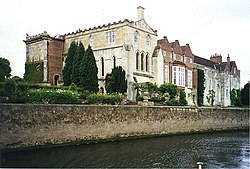
Bishopthorpe Palace
Bishopthorpe Palace is the official residence of the Archbishop of York at Bishopthorpe, North Yorkshire, England. The palace is located on the River Ouse and is approximately 3 miles (4.8 km) south of York, which is the location of the diocese's cathedral, York Minster.

1.1 km
St Andrew's Church, Bishopthorpe
St Andrew's Church is the parish church of Bishopthorpe, a village in the City of York in England.
Bishopthorpe had a church from the 13th century, with Old St Andrew's Church dating from 1768. However, the building regularly flooded, and following a major inundation in 1892, it was decided to construct a new building, on a site further from the river. It was designed by C. Hodgson Fowler, and work started in February 1898. In December, the Archbishop of York ascended scaffolding to affix a cross to the gable end of the roof. The church was consecrated on 25 July 1899. The construction cost £5,893, more than budgeted, which meant that more fundraising was required before a tower could be added. Ultimately, the archbishop personally paid for a tower, which was constructed in 1903.
The church is built of sandstone, with a tile roof. It is in the Gothic Revival style. It consists of a nave with aisles, a south porch, and a chancel with a south aisle and north vestry. There is a tower at the west end, with three stages, diagonal buttresses, and battlements. Most of the windows have Perpendicular tracery. It has been Grade II listed since 1985.

1.2 km
Bishopthorpe
Bishopthorpe is a village and civil parish three miles south of York in the City of York unitary authority area and ceremonial county of North Yorkshire, England. Bishopthorpe is close to the River Ouse, and has a population of 3,174, increasing to 3,237 at the 2011 Census. The area of Main Street and the Palace were made a conservation area in 1989 along with other open areas of the village.
The village was historically part of the West Riding of Yorkshire until 1974. It was then a part of the district of Selby District in North Yorkshire from 1974 until 1996. Since 1996 it has been part of the City of York unitary authority.
It was formerly known as St Andrewthorpe, but in the 13th century, Archbishop Walter de Grey bought the manor house and gave it to the Dean and Chapter of York Minster. This became Bishopthorpe Palace, the residence of the Archbishop of York. Many of the roads in Bishopthorpe are named after past Archbishops.