

 English
 Français

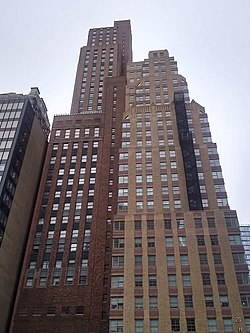
Whitehall Building Annex
Le Whitehall Building Annex est un gratte-ciel situé au 17 Battery Place North dans le Financial District de Manhattan à New York. Il est construit en 1911 et culmine à 129 mètres. Il est l'un des rares gratte-ciel du style Beaux-Arts.
1. Liens externes
Whitehall Building Annex sur CTBUH
Portail des gratte-ciel Portail de New York Portail de la protection du patrimoine
Nearby Places View Menu

19 m
Whitehall Building
The Whitehall Building is a three-section residential and office building next to Battery Park in Lower Manhattan, New York City, near the southern tip of Manhattan Island. The original 20-story structure on Battery Place, between West Street and Washington Street, was designed by Henry Janeway Hardenbergh, while the 31-story Whitehall Building Annex on West Street was designed by Clinton and Russell. The original building and annex are both at 17 Battery Place. Another 22-story addition at 2 Washington Street, an International Style building located north of the original building and east of the annex, was designed by Morris Lapidus.
The original Whitehall Building and its annex has a Renaissance Revival style facade, and the two original structures' articulations consist of three horizontal sections similar to the components of a column—namely a base, shaft, and capital. Since the building is located on landfill along the Hudson River, its foundation incorporates a non-standard design.
The Whitehall Building is named after the nearby estate of New Amsterdam colonial governor Peter Stuyvesant. The original building was built as a speculative development in 1902–1904 for Robert A. and William H. Chesebrough, a real estate company. The annex was built in 1908–1910, and 2 Washington Street was built in 1972. In 2000, the New York City Landmarks Preservation Commission (LPC) designated the Whitehall Building as an official city landmark. The upper floors of the original building and annex were converted to apartments, while the lower floors remain in use as an office building.
37 m
Alliance University (New York City)
Alliance University (formerly Nyack College ( ) was a private Christian university affiliated with the Christian and Missionary Alliance and located in New York City. It offered undergraduate and graduate programs; in addition, it included Alliance Theological Seminary.
In June 2023, the Middle States Commission on Higher Education announced that it would revoke the university's accreditation in December 2023 due to significant and ongoing financial challenges. On June 30, 2023, university leaders announced that it would cease operations as of August 31, 2023.
59 m
Downtown Athletic Club
The Downtown Athletic Club, also known as the Downtown Club, was a private social and athletic club that operated from 1926 to 2002 at 20 West Street, within the Financial District of Lower Manhattan in New York City. The Downtown Athletic Club was known for issuing the Heisman Trophy, an annual award for outstanding college football players that was named after John Heisman, the club's first athletic director.
The Downtown Athletic Club was founded in 1926 as an all-male club. The club bought land for their building near the Hudson River in 1927 and completed the structure in 1930. The building was sold off in 1936 following the club's bankruptcy, but was reacquired in 1950. The club started admitting female members in 1977, and after facing further financial troubles in the late 1990s, sold off part of its building. After the September 11 attacks on the nearby World Trade Center, blockades in the neighborhood rendered the clubhouse largely inaccessible; the club filed for bankruptcy and then shut down.
The 35-story Downtown Athletic Club building was designed in the Art Deco style by Starrett & van Vleck, who also designed the adjacent 21 West Street at the same time. The building housed all of the club's athletic activities, as well as living and dining spaces. Its architectural features include several setbacks to allow light to reach the street, as mandated by the 1916 Zoning Resolution, in addition to the design of the brickwork and the different architectural concessions made for the building's various facilities. 20 West Street was designated by the New York City Landmarks Preservation Commission as an official city landmark in 2000. After the club closed, the building was converted to the Downtown Club, a residential building with condominiums.

85 m
21 West Street
21 West Street, also known as Le Rivage Apartments, is a 33-story building located in the Financial District of Lower Manhattan in New York City, on Morris Street between West Street and Washington Street. It was built in 1929–1931 as a speculative office tower development in anticipation of an increased demand for office space in Lower Manhattan. The building was converted into apartments in 1997 and was renamed Le Rivage.
The building has an Art Deco design with many lavish architectural finishes and a series of setbacks which taper toward the top floors. It was designed by Starrett & van Vleck, who at the same time designed the adjacent Downtown Athletic Club. 21 West Street was listed on the National Register of Historic Places in 1999 and designated a city landmark by the New York City Landmarks Preservation Commission in 1998.

127 m
Skyscraper Museum
The Skyscraper Museum is an architecture museum in the Battery Park City neighborhood of Manhattan in New York City, founded in 1996. The museum focuses on high-rise buildings as "products of technology, objects of design, sites of construction, investments in real estate, and places of work and residence." The Skyscraper Museum also celebrates the architectural heritage of New York and the forces and people who created New York's skyline. Before moving to the current and permanent location in Battery Park City in 2004, the museum was a nomadic institution, holding pop-up exhibitions in four temporary donated spaces around Lower Manhattan since 1996.
The Skyscraper Museum was founded and is directed by Carol Willis, a professor of architectural history and urban studies at Columbia University. It includes two exhibition spaces for both permanent and temporary exhibitions, a bookstore, and a mezzanine with its office, situated above the bookstore. The museum can be reached by a ramp starting in the basement.