

 English
 Français
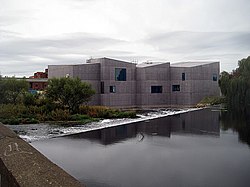
The Hepworth Wakefield
The Hepworth Wakefield est un musée d'art moderne et contemporain situé à Wakefield au Royaume-Uni. Il a été conçu par David Chipperfield et construit par l'entreprise Laing O'Rourke. Son financement, d'un montant de 35 millions de livres, est d'origine publique. Il est nommé en référence à Barbara Hepworth. Il a ouvert en 2011.
Nearby Places View Menu
0 m
The Hepworth Wakefield
The Hepworth Wakefield is an art museum in Wakefield, West Yorkshire, England, which opened on 21 May 2011. The gallery is situated on the south side of the River Calder and takes its name from artist and sculptor Barbara Hepworth who was born and educated in the city. It is the successor of (and subsumed) the municipal art collection, founded in 1923 as Wakefield Art Gallery, which spans the Old Masters to the twentieth century.
The gallery was designed by British architect David Chipperfield, who won an architectural design competition managed by RIBA Competitions and was built by Laing O'Rourke with funding from Wakefield Council, Arts Council England and the Heritage Lottery Fund. Yorkshire Forward, the Homes and Communities Agency, and the European Regional Development Fund have also supported the building of the gallery alongside a number of charitable trusts, corporations and private individuals. The Hepworth Wakefield is a registered charity under English law.
The gallery cost £35 million to build. Five weeks after opening it had received 100,000 visitors. In May 2012 it celebrated its first birthday, having received over 500,000 visitors in the year. In October 2015, the gallery launched the £30,000 biennial Hepworth Prize for Sculpture as part of the celebrations marking its 5th anniversary.

109 m
Chantry Bridge
Chantry Bridge, sometimes known as Wakefield Bridge, is a mediaeval bridge in the city of Wakefield, in West Yorkshire, in England.
In the early 14th century, there was a timber bridge over the River Calder in Wakefield, with Kirkgate connecting the bridge to the town centre. The bridge was damaged by flooding in the 1330s, and a decision was taken to rebuild it in stone.
Construction of the new bridge began in 1342, with spans connecting the north bank to a small island. The Chantry Chapel of St Mary the Virgin was built on the island. The bridge was then completed from the island to the south bank, in similar style, but only the arches supporting the northern part of the bridge have ribs. The chapel was consecrated in 1356, and this is sometimes taken to be the completion date of the bridge.
The bridge was widened by nine feet in 1758. It was painted by J. M. W. Turner in 1797, in which year it was widened by nine feet for a second time. This work was probably designed by John Carr of York and undertaken by Bernard Hartley. Wakefield New Bridge was constructed immediately upstream of Chantry Bridge in 1933, and now carries the large majority of traffic. Chantry Bridge was Grade I listed in 1953.
The bridge has nine arches. The original arches are visible on the downstream side, and are pointed, while the widened section on the upstream side has round arches. Each arch is supported by a platform with a cutwater. There is a plain parapet.

132 m
Chantry Chapel of St Mary the Virgin, Wakefield
The Chantry Chapel of St Mary the Virgin is a chantry chapel in Wakefield, West Yorkshire, England, and is designated a Grade I Listed building by Historic England. It is located south of the city centre on the medieval Chantry Bridge over the River Calder. It is the only survivor of four chantries in Wakefield and the oldest and most ornate of the surviving bridge chapels in England. Others are at St Ives (Cambridgeshire), Rotherham, Derby and Bradford-on-Avon. The chapel has had three west fronts, the original medieval façade having been removed to Kettlethorpe Hall in 1832. The medieval bridge is a scheduled ancient monument.

388 m
Wakefield Kirkgate railway station
Wakefield Kirkgate is one of two railway stations in Wakefield, West Yorkshire, England. Unlike nearby Wakefield Westgate, Kirkgate is unstaffed. It is managed by Northern Trains, but also served by Grand Central and TransPennine Express. The station is on the Hallam, Calder Valley, Pontefract and Huddersfield lines, with a limited number of services to London King's Cross.

402 m
West Yorkshire History Centre
The West Yorkshire History Centre is an archive in Wakefield, in West Yorkshire, in England.
The centre evolved from the West Riding Registry of Deeds, opened on Kirkgate in Wakefield in 1704. This was the first such registry in England. In 1932, the records were transferred to a new building on Newstead Road in the city, later becoming the West Yorkshire Archive Service. It moved to its current building, back on Kirkgate, in 2016, by which time it held more than 10 million records. It is run by West Yorkshire Joint Services.
In addition to the 7 million deeds, the centre holds surviving records of the West Riding of Yorkshire, from 1194 onwards, the National Coal Board collection of records relating to the local area, and the records of Stanley Royd Hospital.
The building was designed by Broadway Malyan. It includes a local history centre on the ground floor, and the archives on the upper floors. These are surrounded by a metal mesh wrap, which is lit with changing colours in the evenings.