Location Image

West Yorkshire History Centre

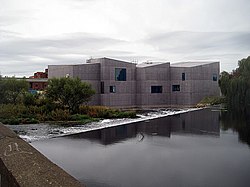
The West Yorkshire History Centre is an archive in Wakefield, in West Yorkshire, in England. The centre evolved from the West Riding Registry of Deeds, opened on Kirkgate in Wakefield in 1704. This was the first such registry in England. In 1932, the records were transferred to a new building on Newstead Road in the city, later becoming the West Yorkshire Archive Service. It moved to its current building, back on Kirkgate, in 2016, by which time it held more than 10 million records. It is run by West Yorkshire Joint Services. In addition to the 7 million deeds, the centre holds surviving records of the West Riding of Yorkshire, from 1194 onwards, the National Coal Board collection of records relating to the local area, and the records of Stanley Royd Hospital. The building was designed by Broadway Malyan. It includes a local history centre on the ground floor, and the archives on the upper floors. These are surrounded by a metal mesh wrap, which is lit with changing colours in the evenings.

Nearby Places View Menu
Location Image
60 m

Battle of Wakefield

The 'Battle' of Wakefield has traditionally been said to have taken place in Sandal Magna near Wakefield in northern England, on 30 December 1460. Recent research demonstrates that it was not a battle in the proper sense of a word, but a small-scale skirmish that resulted in the capture of subsequent death of Richard, Duke of York, his second son, Edmund, Earl of Rutland, and Richard Neville, Earl of Salisbury. For several years before the battle, the Duke of York had become increasingly opposed to the weak King Henry's court and his Queen, Margaret of Anjou. After open warfare broke out between the factions and Henry became his prisoner, he laid claim to the throne, but lacked sufficient support. Instead, in an agreement known as the Act of Accord, he was made Henry's heir to the throne, displacing from the succession Henry and Margaret's 7-year-old son Edward, Prince of Wales. Margaret of Anjou and several prominent nobles were irreconcilably opposed to this accord and massed their armies in the north. Richard of York marched north to deal with them. As the Lancastrians held Pontefract Castle, York made for his manor of Wakefield. Later Yorkist and Tudor accounts claimed his took residence in Sandal Castle, but the manorial accounts show that he stayed in the town itself, probably at the Moot Hall. The traditional accounts give several unlikely reasons for him leaving the supposed safety of Sandal Castle to engage a larger Lancastrian army, but the earliest accounts, documentary and chronicle, are in agreement that the Duke and his followers were ambushed on 29 December, probably as they left Wakefield for York, captured and murdered.
Location Image
246 m

Wakefield Kirkgate railway station

Wakefield Kirkgate is one of two railway stations in Wakefield, West Yorkshire, England. Unlike nearby Wakefield Westgate, Kirkgate is unstaffed. It is managed by Northern Trains, but also served by Grand Central and TransPennine Express. The station is on the Hallam, Calder Valley, Pontefract and Huddersfield lines, with a limited number of services to London King's Cross.
Location Image
278 m

ABC Cinema, Wakefield

The ABC Cinema was a cinema in Wakefield, West Yorkshire that fell into dereliction after its closure. Located in Kirkgate on the corner of Sun Lane, it was designed and built in the Art Deco style for Associated British Cinemas by in-house architect William R. Glen and opened as the Regal Cinema on 9 December 1935. Smaller than many later ABC houses, the Regal seated 1,594 people and had a full stage 26 feet (7.9 m) deep behind the 43 feet (13 m) wide proscenium. The interior was rather plainer than many of Glen's cinemas with concealed lighting under the balcony and at the rear of the ceiling and pendant fittings casting light upwards towards the front of the cinema. Although provision was made for an organ with chambers to the side and above the proscenium, one was never installed. It was renamed ABC in 1962. In 1976 it was divided into three screens with Screen 1 seating 532 in the balcony using the original screen and projection suite and Screen 2 (236 seats) and Screen 3 (170 seats) in the rear stalls area. In this form it reopened on 11 November 1976. In 1986, ABC's cinemas were sold to The Cannon Group. In December 1996, Cineworld opened a multiplex in Wakefield, and in 1997, the ABC closed. In 2007, Blockbuster Entertainment sought planning permission to convert the building into 119 one- and two-bedroom flats, eight shops and a rooftop garden. In 2009, the City of Wakefield granted planning permission, but the project did not go ahead. In December 2013, a property company, PS & S Ltd, applied for planning permission to demolish the building and replace it with a modern apartment block. Plans to demolish the building and replace it with a car park were withdrawn in 2019. In 2020 the site was bought by Wakefield Council which announced plans in June 2021 to demolish the cinema and turn the site into a temporary green space until a new building is designed. Demolition began internally in March 2022, and exterior demolition was completed in May 2023. The Beatles played at the Cinema on Thursday 7 February 1963 as part of the Helen Shapiro Winter Tour, just a few days before they recorded on 11 February, the majority of their first album, Please Please Me. The Beatles had only released one single at this stage – Love Me Do, which had reached number 17 in the charts. The Cinema played host to many such shows in the 1950s and 1960s.
Location Image
360 m

Chantry Bridge

Chantry Bridge, sometimes known as Wakefield Bridge, is a mediaeval bridge in the city of Wakefield, in West Yorkshire, in England. In the early 14th century, there was a timber bridge over the River Calder in Wakefield, with Kirkgate connecting the bridge to the town centre. The bridge was damaged by flooding in the 1330s, and a decision was taken to rebuild it in stone. Construction of the new bridge began in 1342, with spans connecting the north bank to a small island. The Chantry Chapel of St Mary the Virgin was built on the island. The bridge was then completed from the island to the south bank, in similar style, but only the arches supporting the northern part of the bridge have ribs. The chapel was consecrated in 1356, and this is sometimes taken to be the completion date of the bridge. The bridge was widened by nine feet in 1758. It was painted by J. M. W. Turner in 1797, in which year it was widened by nine feet for a second time. This work was probably designed by John Carr of York and undertaken by Bernard Hartley. Wakefield New Bridge was constructed immediately upstream of Chantry Bridge in 1933, and now carries the large majority of traffic. Chantry Bridge was Grade I listed in 1953. The bridge has nine arches. The original arches are visible on the downstream side, and are pointed, while the widened section on the upstream side has round arches. Each arch is supported by a platform with a cutwater. There is a plain parapet.