

 English
 Français

Berwick Infirmary
Berwick Infirmary is a community hospital in Berwick-upon-Tweed, Northumberland, England. It is managed by Northumbria Healthcare NHS Foundation Trust.
Nearby Places View Menu
205 m
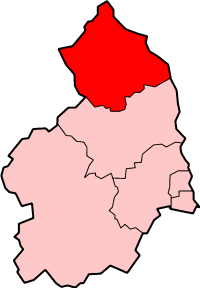
Borough of Berwick-upon-Tweed
Berwick-upon-Tweed was a local government district and borough in Northumberland in the north-east of England, on the border with Scotland. The district had a resident population of 25,949 according to the 2001 census, which also notes that it is the most ethnically homogeneous in the country, with 99.6% of the population recording themselves in the 2001 census as White. It was also the least populated district in England with borough status, and the third-least densely populated local government district (after Eden and Tynedale).
Its main town is Berwick-upon-Tweed, sited immediately to the north of the Tweed estuary. The town is ancient, the scene of a number of battles; it has perhaps the best remaining example of a (almost completely intact) town wall, built for defensive purposes.
On the south of the estuary, the port of Tweedmouth is the point of export of diverse goods, but especially grain and roadstone. The remainder of the borough is rural, bordered to the west by the Cheviot Hills, and to the east by a scenic coastline.
The borough was formed on 1 April 1974 by the merger of the previous borough of Berwick-upon-Tweed with Belford Rural District, Glendale Rural District and Norham and Islandshires Rural District.
Berwick was the first district in Britain to hold a referendum on whether to have a directly elected mayor. This referendum, on 7 June 2001, decided against an elected mayor.
The district was abolished as part of the 2009 structural changes to local government in England effective from 1 April 2009 with responsibilities being transferred to Northumberland County Council, a unitary authority.
247 m
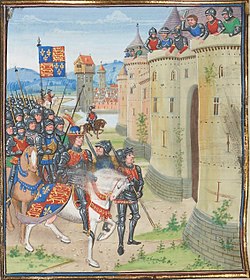
Siege of Berwick (1333)
The siege of Berwick lasted four months in 1333 and resulted in the Scottish-held town of Berwick-upon-Tweed being captured by an English army commanded by King Edward III (r. 1327–1377). The year before, Edward Balliol had seized the Scottish Crown, surreptitiously supported by Edward III. He was shortly thereafter expelled from the kingdom by a popular uprising. Edward III used this as a casus belli and invaded Scotland. The immediate target was the strategically important border town of Berwick.
An advance force laid siege to the town in March. Edward III and the main English army joined it in May and pressed the attack. A large Scottish army advanced to relieve the town. After unsuccessfully manoeuvring for position and knowing that Berwick was on the verge of surrender, the Scots felt compelled to attack the English at Halidon Hill on 19 July. The Scots suffered a crushing defeat, and Berwick surrendered on terms the next day. Balliol was reinstalled as king of Scotland after ceding a large part of his territory to Edward III and agreeing to do homage for the balance.
262 m
Collette Hoard
The Collette Hoard was found in fields near Berwick-upon-Tweed, Northumberland, England by metal detectorist John Minns in April 2005. The hoard is named after Collette, the eight-year-old daughter of Minns, rather than the location it was found at, in order to keep the find location secret.
The hoard included six gold lock rings, believed to have been hair decorations, as well as bracelets, rings and pins and also six socketed axes which could have been used either for woodworking or as weapons, and the first socketed gouge – a tool which would have been used by craftsmen – to be found in Northumberland.

262 m
Siege of Berwick (1318)
The siege of Berwick was an event in the First War of Scottish Independence which took place in April 1318. Sir James Douglas, Lord of Douglas took the town and castle of Berwick-upon-Tweed from the English, who had controlled the town since 1296.