
56–60 Low Petergate is a historic building in the city centre of York, in England. The building was constructed in about 1500 as a terrace of five houses on the north-east side of Low Petergate, for John Stockdale. It is of three storeys, and is five bays long, with timber framing and a jettied front. In about 1630, it was redivided into the current three properties, with chimneys and an attic storey added, and extensions at the rear of each property. In the early 19th century, No. 56 was refronted in brick, while further brick extensions were added to the rear of Nos. 58 and 60. The bay windows at the front of Nos. 58 and 60 date from around 1800, and the shopfront of No. 56 is also 19th-century; the other buildings having 20th-century shopfronts. Inside, some early fixtures and fittings survive, including the 17th-century top section of the staircase in No. 56, and there is a 17th-century plaster overmantel on the first floor, displaying the Stuart coat of arms. There is also a 17th-century cupboard door on the second floor, while other doors date from the 18th century. In No. 58, there is a ground floor room with 18th-century panelling, and on the first floor there is an 18th-century overmantel, while in No. 60 there is a first floor room with 18th-century panelling. The building was Grade II* listed in 1954.

Nearby Places View Menu
Location Image
20 m

York College for Girls

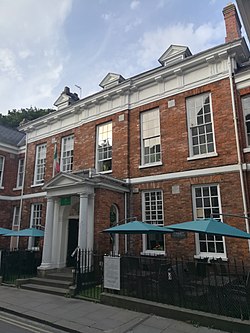
York College for Girls was a girls' school in York, England, founded in 1908 and closed in 1997. The school was founded by the Church Schools Company (later the United Church Schools Trust) and opened with twelve pupils on 24 January 1908 in Low Petergate, York, in a building dating to around 1725. By 1997, the school had about 200 pupils and was in the same buildings with later extensions. In 1996, there were reports of a "cash crisis" and the school closed in 1997. The buildings are Grade II* listed, and after the school closed they became the home of the restaurant La Vecchia Scuola ("the old school" in Italian), which is still in operation.
Location Image
31 m

73, 75 and 77 Low Petergate

73, 75 and 77 Low Petergate is a terrace of late Mediaeval buildings in York, in England. The terrace was constructed in the late 16th century, and originally consisted of four houses. Each is of three storeys with an attic, and each storey is jettied over the one below. They are timber-framed throughout, and this is largely exposed inside the upper floors. In each building, part of the original staircase from the second floor to the attic survives. In No. 75, a large chimney breast with two hearths survives. The street fronts are rendered with stucco, with incisions designed to make it resemble ashlar. Nos. 73 and 77 have original gables, while No. 75 has twin gables which were added in the 17th century. Various extensions have been added to the rear of the terrace, with the largest addition being to No. 73. The houses lie on Low Petergate, one of the most important streets in the city centre, now a major shopping street. In the 19th century, the ground floors were converted into three shops, and the shop front of No. 77 survives, while the others were further altered in the 20th century. With the later house at No. 71, and the earlier ones at Nos. 79 and 81, they form a lengthy range of timber-framed buildings which Nikolaus Pevsner described as "impressive". The terrace has been Grade II* listed since 1954.
Location Image
32 m

The Adams House, York

The Adams House is a historic building in the city centre of York, in England. The house lies on Low Petergate, one of the main streets in the centre of York. It was built in 1772, for John Fountayne, the Dean of York. It originally incorporated a ground floor passageway through which the Deanery could be accessed. Construction cost £1,353 (equivalent to £218,463 in 2023), and the building was immediately let to one of the cathedral vergers, who then sub-let it. At a later date, the ground floor was converted into a shop, incorporating the former passageway. The building was Grade II* listed in 1954. For some time, it was a branch of Café Rouge, before becoming Jimmy's cafe-bar, and in 2022, a Fat Hippo burger bar. The three-storey building is built of brick on a stone base. The original entrance doorway survives, with a second entrance having been created when the passageway was removed; the remainder of the ground floor facade is a shopfront, in similar style. There is a decorated cornice, and an original drainpipe head, with the crest of an elephant, the emblem of Fountayne. The rear facade is plainer, with various sash windows, and some blocked windows. Inside, the ground floor has been altered, but many rooms on the upper floors retain their original plasterwork and fireplaces, the grandest being in the first floor saloon. Two original staircases also survive.
Location Image
39 m

33 Stonegate

33 Stonegate is a historic building in the city centre of York, in England. The timber-framed building was constructed in the early 17th century, probably at the same time as the similar building at 31 Stonegate. Late in the century, it was extended to the rear, in brick. The front was originally pargetted, but this was removed in the late 19th century and replaced by plain plaster with elaborately carved wood. This incorporates the date "1489", but this does not relate to any event in the history of the site. The building has three storeys and an attic, each of which is jettied. The ground floor has a shopfront, and at its right hand end is a bracket supporting a carving of the devil. The devil is believed to have advertised a printing business in the building, a "printer's devil" being a nickname for a printer's assistant. Inside, a late 17th-century staircase rises the height of the building. Several original doors survive, as does the panelling in the front room on the first floor. The building was Grade II* listed in 1954. Since 2017, it has housed the flagship shop of Abraham Moon & Sons, a woollen mill based in Guiseley. A local story states that Laurence Sterne lived at the house for several years, and he would frighten off potential thieves by banging his walking stick against his bedroom wall, a sound which can supposedly still be heard in neighbouring 35 Stonegate.