Location Image

Château d'Aberdour

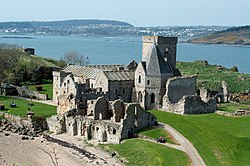
Le château d'Aberdour est un château partiellement en ruine situé à Aberdour, dans la région du Fife en Écosse. Des parties du château remontent aux alentours de 1200, ce qui en fait l'un des deux plus anciens châteaux d'Écosse pouvant être daté et toujours debout, l'autre était le château de Sween dans la région d'Argyll and Bute construit environ à la même période. La plus ancienne partie du château était bâtie sur un site avec vue sur le ruisseau du Dour Burn. L'édifice était alors modeste, consistant en une salle et des chambres attenantes. Au cours des 400 années qui suivirent, le château fut agrandi successivement selon les idées architecturales alors en vigueur. L'édifice devint une maison-tour au XVe siècle et fut agrandi deux fois au cours du XVIe siècle. Le dernier ajout fut réalisé vers 1635, avec des détails raffinés de la Renaissance, et l'ensemble fut complété par un jardin clos à l'est et des jardins en terrasse au sud. Les terrasses, datant du milieu du XVe siècle, constituent l'un des plus anciens jardins d'Écosse, et offrent une vue large à travers le Firth of Forth sur Édimbourg. Ce château est principalement l'œuvre du Clan Douglas, comtes de Morton, qui détenaient Aberdour depuis le XIVe siècle. Les comtes utilisaient Aberdour comme résidence secondaire jusqu'en 1642, lorsque leur résidence principale, le Palais de Dalkeith, fut vendu. Quelques réparations furent faites après un feu à la fin du XVIIe siècle, mais en 1725 la famille acheta Aberdour House non loin et cessa d'entretenir le château. Actuellement, seule l'aile du XVIIe siècle conserve ses toits tandis que la tour s'est majoritairement écroulée. Le château d'Aberdour est maintenant entretenu par Historic Scotland et est ouvert au public toute l'année.

Nearby Places View Menu
Location Image
234 m

Aberdour railway station

Aberdour railway station is a railway station in the village of Aberdour, Fife, Scotland. The station is managed by ScotRail and is on the Fife Circle Line.
Location Image
423 m

Aberdour

Aberdour ( ; Scots: , Scottish Gaelic: Obar Dobhair) is a scenic and historic village on the south coast of Fife, Scotland. It is on the north shore of the Firth of Forth, looking south to the island of Inchcolm and its Abbey, and to Leith and Edinburgh beyond. According to the 2011 census, the village has a population of 1,633. The village's winding High Street lies a little inland from the coast. Narrow lanes run off it, providing access to the more hidden parts of the village and the shoreline itself. The village nestles between the bigger coastal towns of Burntisland to the east and Dalgety Bay to the west. The parish of Aberdour takes its name from this village, and had a population of 1,972 at the 2011 Census.
Location Image
2.5 km

Braefoot Battery

The Braefoot Battery was a World War I coastal defence gun battery defending the Firth of Forth. The battery was constructed in 1915 at Braefoot Point, then part of the Earl of Moray's Donibristle Estate. The site is situated between the new town of Dalgety Bay and Aberdour in Fife.
Location Image
2.6 km

Couston Castle

Couston Castle is an L-plan tower house dating from the late sixteenth or early seventeenth centuries, just north east of Dalgety Bay, at the edge of Otterston Loch in Fife, Scotland. It is built on the site of an earlier building.
Location Image
2.8 km

Inchcolm Abbey

Inchcolm Abbey is a medieval abbey located on the island of Inchcolm in the Firth of Forth in Scotland. The Abbey, which is located at the centre of the island, was founded in the 12th century during the episcopate of Gregoir, Bishop of Dunkeld. Later tradition placed it even earlier, in the reign of King Alexander I of Scotland (1107–24), who had taken shelter on Incholm when his ship was forced ashore during a storm in 1123. It is said he resided there for three days with the Hermit of Incholm. The Abbey was first used as a priory by Augustinian canons regular, becoming a full abbey in 1235. The island was attacked by the English from 1296 onwards, and the Abbey was abandoned as a result of the Scottish Reformation in 1560. It has since been used for defensive purposes, as it is situated in a strategically important position in the middle of the Firth of Forth. A Latin inscription carved above the Abbey's entrance reads: Stet domus haec donec fluctus formica marinos ebibat, et totum testudo perambulet orbem Translated, it has been rendered thus: "Still may these turrets lift their heads on high, Nor e’er as crumbling ruins strew the ground, Until an ant shall drink the ocean dry, And a slow tortoise travel the world round." Inchcolm Abbey has the most complete surviving remains of any Scottish monastic house. The cloisters, chapter house, warming house, and refectory are all complete, and most of the remaining claustral buildings survive in a largely complete state. The least well-preserved part of the complex is the monastic church. The ruins are cared for by Historic Environment Scotland, which also maintains a visitor centre near the landing pier (entrance charge; ferry from South Queensferry). In July 1581 stones from the abbey were taken to Edinburgh to repair the Tolbooth. Among the Abbots of Inchcolm was the 15th-century chronicler Walter Bower.