

 English
 Français

Saltaire United Reformed Church
Saltaire United Reformed Church (originally Saltaire Congregational Church) is a church at Saltaire, West Yorkshire, England. Commissioned and paid for by Titus Salt in the mid 19th century, the church is a Grade I listed building and sits within the Saltaire World Heritage Site.
Nearby Places View Menu

52 m
Saltaire railway station
Saltaire railway station serves the Victorian model village of Saltaire near Shipley in West Yorkshire, England. It is situated 3+1⁄2 miles (6 km) north of Bradford Forster Square.

189 m
Saltaire
Saltaire is a Victorian model village near Shipley, West Yorkshire, England, situated between the River Aire, the railway, and the Leeds and Liverpool Canal. Salts Mill and the houses were built by Titus Salt between 1851 and 1871 to allow his workers to live in better conditions than the slums of Bradford. The mill ceased production in 1986, and was converted into a multifunctional location with an art gallery, restaurants, and the headquarters of a technology company. It is a UNESCO World Heritage Site and on the European Route of Industrial Heritage.

193 m
Peace Museum
The Peace Museum in Saltaire, West Yorkshire is the only museum in the UK dedicated to the history and stories of peace, peacemakers and the peace movement.
The initial idea of creating a peace museum arose in the mid-1980s from Gerald Drewett of the Give Peace a Chance Trust. In 1990 this was carried forward when Shireen Shah, an MA student at Bradford University’s Peace Studies Department, wrote a dissertation proposing a ‘Museum for Peace’. Two years on, the International Network of Museums for Peace held its first conference at the University of Bradford in 1992, during which it was proposed that a Peace Museum be established in Bradford. A committee was established to seek finance and general support for the idea. Initially called ‘The National Peace Museum Project’, the museum was established in 1994 through a five-year grant from the Joseph Rowntree Charitable Foundation and operated from a temporary site in Bradford in the Wool Exchange. In 1998 the museum moved to the top floor of 10 Piece Hall Yard, in Bradford city centre.
The museum has a varied temporary exhibition programme, hosting several exhibitions and displays throughout the year. Past exhibitions have included 'A force for peace? The History of European Cooperation' (ended 2016) exploring the peace history behind the European Union, 'Challenging the Fabric of Society' showcasing the protest banners that are part of its textile collection (until March 2017), and 'Remembering the Kindertransport' to commemorate Holocaust Memorial Day (until April 2017).
The museum closed its Piece Hall Yard site in 2020 and reopened at Salts Mill, Saltaire, in August 2024. The museum's artifacts had been stored in the basement of Salts Mill in the interim.
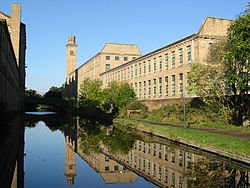
193 m
Salts Mill
Salts Mill (sometimes spelled Salt's Mill) is a former textile mill, now incorporating an art gallery, shops, restaurant, and spaces to rent in Saltaire, Bradford, West Yorkshire, England. It was commissioned and financed by Sir Titus Salt and opened in 1853. The construction involved multiple firms, including J and W Beanland, a respected Bradford building company known for their skilled craftsmanship. At that point, the mill was the largest industrial building in the world by total floor area. The present-day 1853 Gallery takes its name from that date. The mill has many paintings by local artist David Hockney on display.
The Mill and surrounding village of Saltaire was financed and built by the 19th century industrialist and philanthropist Sir Titus Salt after he observed other textile factories and was disappointed by the working conditions he saw there. At the time mill working conditions were commonly poor, with most workers suffering disease, low wages and labour exploitation. Dangerous machinery and long hours, sometimes exceeding 16 hour working days, resulted in frequent accidents. Titus Salt acknowledged this and built a factory and surrounding village with which he intended to improve the working conditions for his employees. It is a grade II* listed building. The mill closed in 1986 and the following year it was sold to Jonathan Silver, who began a long renovation scheme.