

 English
 Français

St Mary's Church, Woolton
St Mary's Church is in Church Road, Woolton, Liverpool, Merseyside, England. It is an active Roman Catholic parish church in the Inland Family of Parishes of the Liverpool South Deanery situated in the Archdiocese of Liverpool. The church is recorded in the National Heritage List for England as a designated Grade II listed building.
1. History
The church was built in 1859–60, and designed by R. W. Hughes, an architect from Preston. It was opened on 28 October 1860. The church was re-decorated in 1981–82, and the font was moved to the front of the church. The church's foundation stone was laid 11 September 1859. The Church was known as Saint Benet's until 1881 when it became known as Saint Mary's.
1. = The Catholic Mission in Woolton =
A Catholic community has been present for over 300 years. It has had a very varied and interesting history. Notable dates include:
1. = Priests who have served at Saint Mary's =
1862–1873: J.P. O’Brien OSB 1873–1880: P. Whittle OSB 1880–1891: W. Bede Prest OSB 1891–1894: H.G. Murphies OSB 1895–1896: J.W. Richards OSB 1896–1897: C.J. Fitzgerald OSB 1897–1909: Ambrose A. Pereria OSB 1909: A.F. Fleming OSB 1909–1913: Vincent Corney OSB 1913–1919: H.M. Campbell OSB 1919–1928: J.M. Kelly OSB 1928: E.D. Fennell OSB Assistant priests during the above years
B.M. Sutter OSB, A.J. McEvoy OSB, T.L. Almond OSB, Vincent Corney OSB, H.W. McKay OSB, P. O’Callaghan OSB, J.R. Riley OSB, J.G. Dolan OSB, C de Neubourg OSB, J.R. Rylance OSB, L.S. Cave OSB, E.D. Fennell OSB, R.V. Gilbertson OSB, J.M. Kelly OSB, F.A. Harrington OSB, T.P. Worsley-Warwick OSB In 1928 the Benedictines then departed after two centuries of service; Mill Hill Fathers become Rectors
1928–1930: Fr. Herman Drontman 1930–1931: Fr. Martin Onsten Assistant: Fr. William Ross The first secular priest Fr. Charles Gelderd was appointed by Archbishop Richard Downey in 1931.
As Fr. Pat O’Brien's retirement approached, the Congregation of the Most Holy Redeemer better known as the Redemptorists were asked by Archbishop Patrick Kelly to take over the Pastoral Care of St. Mary's. This would be in addition to their parish of Our Lady of the Annunciation of Bishop Eton. The Parishes would not be merged but would continue to exist in their own right.
In 2025, St Mary's became part of South Liverpool's Inland Family of Parishes along with Our Lady of the Annunciation of Bishop Eton, Our Lady of the Assumption, Christ the King & Our Lady and St John Vianney parishes. It was announced in May 2025 that beginning in autumn 2025, pastoral responsibility for St Mary’s will return to the Archdiocese. Fr Peter McGrail, who teaches theology at Liverpool Hope University, will be appointed Parish Priest for both St Mary’s and St John Vianney Parishes, Fr Peter Murphy will be appointed as Assistant Priest for a period of two years.
1. Architecture


1. = Exterior =
St Mary's is constructed in red sandstone and has a slate roof. It is orientated with the ritual east facing the northwest. The plan consists of a five-bay nave with a north porch but without aisles, large north and south transepts, a chancel with north and south chapels and sacristies. There is no tower. At the west end are diagonal buttresses, an entrance, and pointed windows containing Geometric tracery. The windows along the sides of the nave have two lights. In the south transept is a four-light window, and the north transept contains two two-light windows with a rose window above. In the chapel is a five-light window flanked by diagonal buttresses. The chapels are gabled with two-light windows. The south sacristy has one and two lights, with a rose window in the gable.
1. = Interior =
Inside the church, the high altar and reredos date from 1865, and were probably designed by E. W. Pugin. They were separated in 1948–50 by Weightman and Bullen, who placed the reredos against the east wall. The stained glass in the east window dates from 1878, and is a typical design by the Belgian stained glass painter Jean-Baptiste Capronnier. The two-manual pipe organ was built by Franklin Lloyd in 1895, and is situated in a gallery on the north wall of the church at the west end.
1. = Stained glass windows =
Source: The main window was donated by the Jump family. At the apex is a representation of the last supper. St Benedict and Scholastica are pictured below and included because of the Parish being founded by Benedictines. The saints below are (left to right) St Baldwin (a Benedictine reformer), St James, St Mary, St Henry and St Anne. These last four Saints are name saints of members of the Jump family buried outside near to the church porch. The inscription reads "Donante Jacob Jump luceo deo in domo" which translates as Dontated by James Jump to bring light to God’s house. Above the word Donante can be seen the makers inscription J. P. Carpronnier, Brussels. Jean-Baptiste Capronnier (1814-1891) was a Belgian stained glass painter. Born in Brussels in 1814, he had much to do with the modern revival of glass-painting, and first made his reputation by his study of the old methods of workmanship, and his clever restorations of old examples, and copies made for the Brussels archaeological museum. He carried out windows for various churches in Brussels, Bruges, Amsterdam and elsewhere, and his work was commissioned also for France, Italy and England. At the Paris Exhibition of 1855 he won the only medal given for glass painting. He died in Brussels in 1891. The window which can be found above the Lady Altar depicts St John the evangelist, St Mary and St Joseph. An inscription read "Pray for the soul of Joanna Simpson who died September 8, 1859". A Miss Simpson gave a gift £1000 towards the building of this Church The window above our Sacred Heart Altar has images of St Elizabeth, St Anne and St Robert. All three saints are saint names of members of the Roskell family. Also look at the base of the main altar for the inscription about Joanna Roskell The window in the South Transept was erected to the memory of Francis and Clare Reynolds, buried outside by the church entrance, who lived in what is now Reynolds Park. The window depicts St Francis and St Clare. Francis and Clare Reynolds were members of the third order of St Francis. The other two saints Elizabeth of Hungary and St Vincent de Paul are patrons of the third order. In the small panes below each saint are scenes from their life. Central to the rose window, found in the North Transept is Our Lady of Perpetual Succour. This icon was brought to Liverpool in 1866 by the Redemptorists.
1. Associated buildings


1. = Presbytery =
The presbytery was built in 1864, and designed by E. W. Pugin. It is constructed in stone, and has a slate roof. The presbytery has two storeys and a front of three bays, the outer bays projecting under gables. In the centre bay is a gablet, and the third bay contains a single-storey canted bay window. The presbytery is connected on the left by a single-storey corridor with a central gabled entrance and a ridge dormer. It is designated as a Grade II listed building.
1. = Parish Centre (Formally Much Woolton Catholic Primary School) =
The school was built in 1869, with its entrance in Mount Street. It is constructed in red sandstone with a slate roof. The school is in two storeys and has a nine-bay front, the central bay projecting forward under a gable. The windows in the ground floor have three lights under ogee heads; those in the upper floor have two lights under cusped heads. In the gable of the projecting wing is a rose window. The school is also listed at Grade II. The school building is now used at the Parish Hall and the ground floor is a Nursery.
1. Commonwealth War Graves
Commonwealth War Graves Commission The following war dead are buried in Saint Mary's Cemetery CAPTAIN J F CREAN Died 17 October 1918 Age 41 years old PRIVATE ALFRED TANKERSLEY LOWE Died 24 June 1919 Age 23 years old TROOPER FREDERICK QUICK Died 1 August 1943
1. See also
Grade II listed buildings in Liverpool-L25
1. References and notes
Notes
Citations
Nearby Places View Menu
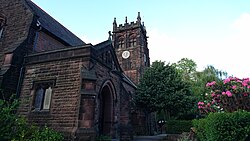
St Peter's Church, Woolton, Liverpool

Woolton Picture House

Woolton
