

 English
 Français

Cramond Kirk
Cramond Kirk est une église située dans le bourg de Cramond au nord-ouest d'Édimbourg, en Écosse. Construit sur le site d'un ancien fort romain, certaines parties de la Cramond Kirk datent du XIVe siècle et le clocher de l'église est considéré comme la partie la plus ancienne.
1. Références
(en) Cet article est partiellement ou en totalité issu de l’article de Wikipédia en anglais intitulé « Cramond Kirk » (voir la liste des auteurs).
1. Liens externes
Site officiel Portail du protestantisme Portail de l’architecture chrétienne Portail de l’Écosse Portail des monuments classés au Royaume-Uni
Nearby Places View Menu
0 m
Cramond Kirk
Cramond Kirk is a church situated in the middle area Cramond parish, in the north west of Edinburgh, Scotland. Built on the site of an old Roman fort, parts of the Cramond Kirk building date back to the fourteenth century and the church tower is considered to be the oldest part.
Next door to the Kirk there is the Manse which has been a home for the Minister of Cramond Kirk for centuries. The existing Manse was constructed in three parts, as extensions were needed to the original building.

54 m
Cramond Tower
Cramond Tower is a fifteenth-century tower house in the village of Cramond to the north-west of Edinburgh, Scotland.

179 m
River Almond, Lothian
The River Almond (Scottish Gaelic: Abhainn Amain) is a river in Lothian, Scotland. It is approximately 28 miles (45 km) long, rising at Hirst Hill in Lanarkshire near Shotts, running through West Lothian and draining into the Firth of Forth at Cramond, Edinburgh. The name Almond/Amon is simply old Celtic for "river".

208 m
Cramond Roman Fort
Cramond Roman Fort is a Roman-Era archaeological site at Cramond, Edinburgh, Scotland. The settlement may be the "Rumabo" listed in the 7th-century Ravenna Cosmography.
The fort was established around 140 AD and occupied until around 170 AD, with a further period of occupation from around 208 to 214 AD. Among the many archaeological finds, one of the most famous is a sculpture known as the Cramond Lioness.
223 m
Cramond
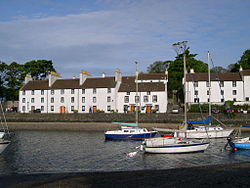
Cramond Village (; Scottish Gaelic: Cair Amain) is a village and suburb in the north-west of Edinburgh, Scotland, at the mouth of the River Almond where it enters the Firth of Forth.
The Cramond area has evidence of Mesolithic, Bronze Age and Roman activity. In modern times, it was the birthplace of the Scottish economist John Law (1671–1729). Cramond was incorporated into the City of Edinburgh by the Edinburgh Boundaries Extension and Tramways Act 1920 (10 & 11 Geo. 5. c. lxxxvii).