Broad Street est une rue de New York.

1. Situation et accès

Elle est située dans le quartier de Financial District, dans l'arrondissement de Manhattan.

1. Origine du nom

Le nom « Broad Street » reflète la transformation d'un large canal à une large rue.

1. Historique

« Broad Street », était autrefois connue sous le nom de « Heere Gracht » (canal des seigneurs en néerlandais) dans le vieux New Amsterdam. Broad Street était à l'origine un canal, un bras de mer, de l'East River, qui était bordé de deux rangées robustes de maisons de trois étages, avec des sentiers devant. Construit sous l'administration de Pieter Stuyvesant, le « Broad Canal » devint le premier embarcadère de Manhattan pour le ferry reliant Manhattan à Brooklyn, plus tard connu sous le nom de Fulton Ferry (en). Le canal a été comblé à partir de 1676, car les marchands de fruits et légumes, y compris les Amérindiens arrivant en canoë depuis Long Island, avaient laissé la zone encombrée de détritus, si bien que de moins en moins d'embarcations pouvaient emprunter le canal. Les allées devant les rangées de maisons le long du canal ont été pavées en 1676, tandis que la chaussée a été pavée pour la première fois en 1693.

1. Bâtiments remarquables et lieux de mémoire

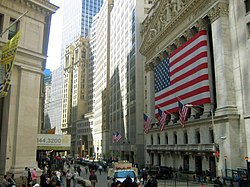
Plusieurs sociétés américaines y ont leur siège, telles que la banque Goldman Sachs. Le siège du New York Stock Exchange se trouve au n°18 de la rue. La sculpture Fearless Girl y est installée en 2018.

1. Notes et références

(en) Cet article est partiellement ou en totalité issu de l’article de Wikipédia en anglais intitulé « Broad Street (Manhattan) » (voir la liste des auteurs).

Portail des routes Portail de New York

Nearby Places View Menu
Location Image
14 m

Millennium High School (New York City)

Millennium High School is a selective public high school for grades 9 through 12 in Manhattan. It is operated by the New York City Department of Education in Region 9. The Phoenix is the school's mascot, meant to symbolize the school rising from the ashes of the World Trade Center following the September 11 attacks. In 2016, the school received more than 6,000 applications for 170 seats, yielding an acceptance rate of less than 3%. Admission to MHS is based on selective criteria including a middle school GPA of 90 or above, attendance, and state test scores in reading and math.
Location Image
28 m

American Bank Note Company Building

The American Bank Note Company Building is a five-story building at 70 Broad Street in the Financial District of Manhattan in New York City. The building was designed by architects Kirby, Petit & Green in the neo-classical style, and contains almost 20,000 square feet (1,900 m2) of space, with offices and residences on the upper floors. The exterior consists of a main facade on Broad Street with two columns, as well as side facades with pilasters on Beaver and Marketfield Streets. The building was erected in 1908 as the home of the American Bank Note Company, a leading engraving company that produced banknotes, currency, stamps, and stock certificates. The company had previously occupied several other sites in Lower Manhattan, and it developed a printing plant in the Bronx after 70 Broad Street was completed. After the company sold the American Bank Note Company Building in 1988, the structure was sold to numerous owners, and renovated into offices and residences. The American Bank Note Company Building is a New York City designated landmark and listed on the National Register of Historic Places (NRHP). It is also a contributing property to the Wall Street Historic District, a NRHP district created in 2007.
Location Image
36 m

Broad Street (Manhattan)

Broad Street is a north–south street in the Financial District of Lower Manhattan in New York City. Originally the Broad Canal in New Amsterdam, it stretches from today's South Street to Wall Street. The canal drew its water from the East River, and was infilled in 1676 after numerous fruit and vegetable vendors made it difficult for boats to enter the canal. Early establishments on Broad Street in the 1600s included the Fraunces Tavern and the Royal Exchange. Later on the area became the center of financial activity, and all smaller buildings in turn were replaced with grand banks and stock exchange buildings. Most of the structures that stand today date from the turn of the 20th century, along with more modern buildings constructed after the 1950s.
Location Image
69 m

55 Broad Street

55 Broad Street is a 30-story building at Broad Street and Beaver Street in the Financial District of Manhattan in New York City, New York. It adjoins 15 William, a skyscraper to the east. The building was constructed from 1964 to 1967, and initially operated as the headquarters of the trading firm Goldman Sachs from 1967 to 1983. It continued as an office building afterward, although it was vacant for renovations from 1991 to 1995. In 2023, renovations began to convert the building from commercial space into residential apartments. The project is expected to create 571 apartments and to finish in around 2025. The building was owned by the Rudin Management Company from 1964 to 2023; the building was taken over by Silverstein Properties and Metro Loft for the redevelopment effort, although Rudin maintains a stake in the project. Ares Real Estate Group has also invested in the redevelopment venture.
Location Image
87 m

Drexel Burnham Lambert

Drexel Burnham Lambert Inc. was an American multinational investment bank that was forced into bankruptcy in 1990 due to its involvement in illegal activities in the junk bond market, driven by senior executive Michael Milken. At its height, it was a Bulge Bracket bank, as the fifth-largest investment bank in the United States. The firm had its most profitable fiscal year in 1986, netting $545.5 million, which represented the most profitable year ever for a Wall Street firm at the time, equivalent to $1.32 billion in 2024. Milken, who was Drexel's head of high-yield securities, was paid $295 million, the highest salary that an employee in the modern history of the world had ever received. Even so, Milken deemed his salary to be insufficient for his contributions to the bank, and received $550 million the next fiscal year. Drexel steered numerous large corporate takeovers during the 1980s. However, Drexel's excessive ambition caused the firm to veer into criminal behavior. Eventually, it abused the junk bond market and became involved in insider trading. In February 1990, Drexel filed for Chapter 11 bankruptcy to avoid being seized by the Securities and Exchange Commission. It was the first Wall Street firm to be forced into bankruptcy since the Great Depression.