The Eagle & Child is a pub on High Petergate, in the city centre of York, in England. The building was constructed in the early 17th century, as a three-storey timber-framed building, with attics and a jettied front. In the 18th century, the building was altered internally, and a brick extension was added at the rear, shared with the neighbouring Petergate House. The building's staircase survives from this period. Late that century, bays were added at the front, which survive at the first and second-floor levels. There is a large chimney between the front and rear rooms of the original part of the building, with fireplaces surviving from the 17th, 18th and early 19th centuries. The building was further altered in the 20th century, and the ground floor shopfront dates from this era. By the mid-1960s, the building was a restaurant, when the Rolling Stones signed their names in lipstick on the wall of the top floor, graffiti which has been preserved. In 1977, the restaurant became Plunketts, which operated until 2015. That year, the Leeds Brewery converted it into the Eagle & Child pub, the name taken from a pub which operated on The Shambles from the 1700s until 1925. In 2017, it was taken over by Camerons Brewery, who refurbished the pub. The building has been Grade II* listed since 1954.

Nearby Places View Menu
Location Image
12 m

Petergate House

Petergate House (or Oratory House) is a Grade II* listed building in the city centre of York, in England. A previous building on the site was constructed about 1500, and its later owners included Thomas Herbert and Henry Swinburne. William Turner bought it in 1723, and largely demolished it, only a single passageway surviving. The new house was of three storeys and seven bays, with a stucco front, lined to resemble stonework, while the rear is of brick. In the 19th century, a new mansard roof was added, as was a two-storey semicircular bay to the rear. The interior was also largely remodelled, and the staircase was altered and moved. From the original fittings, several fireplaces survive, as does much of the decoration of the left-hand front room on the ground floor. The top of the staircase includes some reused balusters from about 1700. The building serves as the rectory for the York Oratory. It is the home of the Fathers of the Oratory and its garden is occasionally opened to the public.
Location Image
15 m

5 High Petergate

5 High Petergate is a historic building in the city centre of York, in England. The building originated as a three-storey timber-framed building, constructed in about 1600. In about 1700, it was rebuilt in brick, retaining three storeys, and also having attics and a cellar. In the early 19th century, extensions were added at the rear, while in the 20th century, a shopfront was inserted at ground floor level, facing onto Low Petergate. The building was Grade II* listed in 1954. The brick front is limewashed. It is topped by a cornice, with a drainpipe head in the centre, dated 1763. Inside, much early plasterwork survives. The building's main staircase dates from the early 19th century, while its rear staircase is late 18th-century. The front room on the first floor is panelled, and has pilasters of the Ionic order flanking the fireplace.
Location Image
33 m

6–7 Precentor's Court

6 and 7 Precentor's Court are an historic pair of buildings in the English city of York, North Yorkshire. Grade II listed and standing on Precentor's Court, the buildings date to the mid-19th century, with No. 7 having earlier origins. The properties were renovated in the 20th century. Rachael Epworth, a pawnbroker, formerly lived at the property. Henry Hardcastle purchased the property from her. A. Ayer Carr, a new member of the Yorkshire Philosophical Society, was living at No. 6 in 1900. 6 Precentor's Court was used as the exterior filming location for the home of the lead character Patience Evans in the television drama Patience.
Location Image
36 m

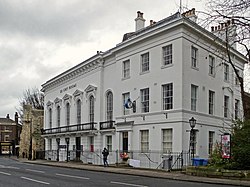
De Grey Rooms

The De Grey Rooms is a historic building in the city of York, England. It was built in 1841–1842 and is a Grade II* listed building.