

 English
 Français
Thornhill (Stirling)
Thornhill est un village situé dans le Stirling, en Écosse.
Nearby Places View Menu
401 m
Thornhill, Stirling
Thornhill (Scottish Gaelic: Cnoc na Driseig) is a village in the Scottish council area of Stirling. It lies 14 miles north west of Stirling itself, south of Callander, east of Aberfoyle and west of Doune.
Historically part of Perthshire, the village is in the civil parish of Kincardine and the church parish of Norrieston (separated ecclesiastically from Kincardine in 1877), named from the much earlier village of Norrieston, which lay a little to the east of Thornhill. It is situated on a slight elevation at the western edge of the Carse of Stirling, an area of flat agricultural land which forms the upper part of the floodplain of the River Forth. Much of the land within the Carse was bogland until the late 18th century when concerted efforts were made to clear away the peat and expose the fertile clay soil below. Flanders Moss, the largest remaining area of lowland bog in Scotland and a site of special scientific interest, lies to the south west.
The village lies on a traditional east–west route from Dunblane to Aberfoyle which passes the Old Post Cottage and was planned and founded at the end of the seventeenth century.
The 2001 census population for the area covered by the Thornhill and Blairdrummond Community Council is 1,109.
Thornhill has one primary school which in the session 2009-2010 had 62 pupils from the village and surrounding area.
The ruins of a possible Iron Age broch lie at Boquhapple about 1 mile north of Thornhill. A mound of rubble about 30 metres (100 ft) in diameter and the earthworks are all that remain today.
The name Thornhill is supposedly derived from the thorn covered ridge on which the village is situated. Thornhill was founded as an early planned village in 1696 and most buildings date from the 18th, 19th and 20th century.
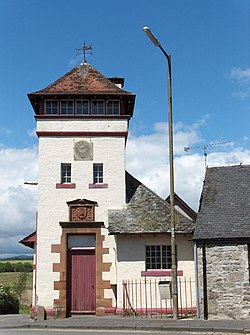
It is believed to have the smallest Masonic Lodge in Scotland.
Thornhill has a community hall with a main hall, meeting rooms, kitchen, changing rooms with showers and parking. The hall is available for the use of locals and other groups.
Thornhill has one pub, The Lion and Unicorn, located on Main Street. It is thought to predate the founding of the village, starting life as a drovers' inn, possibly as early as 1635.

3.4 km
Coldoch Broch
Coldoch Broch is an Iron Age broch located in Stirlingshire in central Scotland (grid reference NS69649813).
5.1 km
Kilmadock
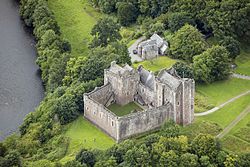
Kilmadock parish (Scottish Gaelic Cille Mo Dog), named for Saint Cadoc, containing the settlements of Doune, Deanston, Buchany, Argaty, Hill of Row, Drumvaich, and Delvorich, is situated in Stirling council area, Scotland, and is on the southern border of the former county of Perthshire. Its length is 10 miles (16 kilometres), its breadth from 2–8 mi (3–13 km), and with an area of 24,521 acres (9,923 hectares).
The River Forth runs along its southern boundary, and the River Teith runs east-south-eastward through the centre. A flat tract of considerable breadth lies along the Forth Valley, flanked on each side by a hill-ridge. The valley is traversed by the Teith, and an upland tract, part of the Braes of Doune, ascends to the summit of Uamh Mhòr on the northern boundary.

5.3 km
Deanston
Deanston (Scottish Gaelic: Baile an Deadhain) is a village in the Stirling council area, Scotland, on the south bank of the River Teith east of Doune, in south-west Perthshire. It is a part of the parish of Kilmadock.

5.4 km
Deanston distillery
Deanston distillery is a Single Malt Scotch whisky distillery and it is the largest distillery owned by Scotch whisky producer CVH Spirits Limited, who also own Bunnahabhain Distillery on the Isle of Islay and Tobermory distillery on the Isle of Mull. located on the banks of the River Teith, eight miles from the historic town of Stirling, at the gateway to the dramatic Loch Lomond & Trossachs National Park.
Deanston Distillery started life in 1785 as a cotton mill designed by Sir Richard Arkwright, and remained as such for 180 years until it was transformed into a distillery in 1966. The constant supply of pure water from the River Teith contributed to the decision to turn the mill into a distillery and Deanston is now the only distillery in Scotland to be self-sufficient in electricity, with power generated by an on-site hydro-energy facility. Deanston sits in the Highland single malt region of Scotland and produces whisky which is handmade by ten local craftsmen, un-chill filtered, natural colour and bottled at a strength of 46.3% ABV.