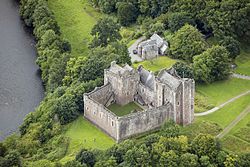
Kilmadock parish (Scottish Gaelic Cille Mo Dog), named for Saint Cadoc, containing the settlements of Doune, Deanston, Buchany, Argaty, Hill of Row, Drumvaich, and Delvorich, is situated in Stirling council area, Scotland, and is on the southern border of the former county of Perthshire. Its length is 10 miles (16 kilometres), its breadth from 2–8 mi (3–13 km), and with an area of 24,521 acres (9,923 hectares). The River Forth runs along its southern boundary, and the River Teith runs east-south-eastward through the centre. A flat tract of considerable breadth lies along the Forth Valley, flanked on each side by a hill-ridge. The valley is traversed by the Teith, and an upland tract, part of the Braes of Doune, ascends to the summit of Uamh Mhòr on the northern boundary.

Nearby Places View Menu
Location Image
1.1 km

Deanston

Deanston (Scottish Gaelic: Baile an Deadhain) is a village in the Stirling council area, Scotland, on the south bank of the River Teith east of Doune, in south-west Perthshire. It is a part of the parish of Kilmadock.
Location Image
1.3 km

Deanston distillery

Deanston distillery is a Single Malt Scotch whisky distillery and it is the largest distillery owned by Scotch whisky producer CVH Spirits Limited, who also own Bunnahabhain Distillery on the Isle of Islay and Tobermory distillery on the Isle of Mull. located on the banks of the River Teith, eight miles from the historic town of Stirling, at the gateway to the dramatic Loch Lomond & Trossachs National Park. Deanston Distillery started life in 1785 as a cotton mill designed by Sir Richard Arkwright, and remained as such for 180 years until it was transformed into a distillery in 1966. The constant supply of pure water from the River Teith contributed to the decision to turn the mill into a distillery and Deanston is now the only distillery in Scotland to be self-sufficient in electricity, with power generated by an on-site hydro-energy facility. Deanston sits in the Highland single malt region of Scotland and produces whisky which is handmade by ten local craftsmen, un-chill filtered, natural colour and bottled at a strength of 46.3% ABV.
1.4 km

Doune Hillclimb

Doune Hillclimb, Carse of Cambus, near Doune in the district of Stirling, Scotland, is the home of the only round of the British Hill Climb Championship currently to be held in Scotland (Bo'ness, Fintray and the Rest And Be Thankful have featured in the past). The course has been 1476 yards (1350m) in length since 1977. However, from the first meeting in 1968 until 1973 the start line was around 33 yards (30m) further back, and from 1974 until 1976 it was located beyond what is currently the first corner. Prior to 1968, Lothian Car Club ran rounds of the British Hill Climb Championship at the Bo'ness Hillclimb from 1948 until 1967, when a house estate was built over part of the Bo'ness track. In 1967 the hillclimb track at Doune was designed by Ray Fielding and built with the first event taking place in April 1968. The current outright record holder is Alex Summers, who set a time of 34.21 seconds on 19 June 2022. Video of a 35.05 second run by Jos Goodyear in his GWR Raptor can be seen here: [1] For many years, Doune Hillclimb hosted rounds of the Scottish Hillclimb Championship in April, June and September each year, and rounds of the British Hillclimb Championship in June and September. No meetings were held in 2020 or in April 2021 due to the global COVID-19 pandemic. The British Hillclimb Championship was scheduled to visit Doune in June 2021, but not in September of that year.
Location Image
1.9 km

Doune railway station

Doune was a railway station located in Doune, in the council area of Stirling, Scotland. The station was rebuilt in typical Caledonian Railway style in the early 1900s after the completion of the Callander and Oban Railway in 1880. It closed on 1 November 1965 and was demolished around 1968. The site was used by a timber merchant for many years. In the late 1990s a private housing estate was built on the station site. Although little or no trace of the station remains, the station house still stands at the entrance to the housing development.