Location Image

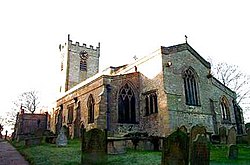
Church of St Mary and St Alkelda, Middleham

The Church of St Mary and St Alkelda is a Church of England parish church in Middleham, Richmondshire, North Yorkshire. The church is a grade I listed building, and it dates from the 13th century.

1. History

The church was made a collegiate church in 1477 by Richard, Duke of Gloucester (later Richard III). Richard III's young son and heir, Edward of Middleham, Prince of Wales, may possibly have been buried in the church after his death nearby in Middleham Castle in 1484. The collegiate body of the church consisted of a dean, six chaplains, four clerks and six choristers. The church was a Royal Peculiar until 1856, at which point the Dean was replaced by a Rector. On 15 February 1967, the church was designated a Grade I listed building.

1. Clock

The current clock with two faces and Cambridge Quarters was built by Potts of Leeds and set going August 1884.

1. Present day

Today, the church is part of the benefice of "Middleham w Coverdale and E Witton and Thornton St" in the Archdeaconry of Richmond and Craven of the Diocese of Leeds. The parish stands in the Conservative Evangelical tradition of the Church of England. The benefice has not passed resolutions rejecting the ordination of women.

1. Notable clergy

Harry Topham, clergyman and cricketer, served as rector from 1903 to 1925

1. See also

Grade I listed buildings in North Yorkshire (district) Listed buildings in Middleham

1. References


1. External links

Benefice website A Church Near You entry

Nearby Places View Menu
Location Image
110 m

Middleham

Middleham ( MID-əl-əm; meaning "middle ham", i.e. "middle village") is a market town and civil parish in the district and county of North Yorkshire, England. It lies in Wensleydale in the Yorkshire Dales, on the south side of the valley, upstream from the confluence of the River Ure and River Cover. There has been a settlement there since Roman times. It was recorded in the 1086 Domesday Book as Medelai.
Location Image
157 m

Wensleydale Hotel

The Wensleydale Hotel is a historic building in Middleham, a town in North Yorkshire, in England. The hotel was built around 1800 as an inn named The White Swan. The building was grade II listed in 1985. In 2019, new owners renamed it after Wensleydale, and created a restaurant, the Tack Room. In 2025 it was put for sale for £800,000, at which time it had 17 bedrooms, a restaurant, private dining room, and bar. The hotel is rendered and has a stone slate roof. It has three storeys and is three bays wide. In the centre is a projecting Doric portico, and to its left is a 20th-century three-light window. The windows on the upper floors are sashes in stone surrounds.
Location Image
170 m

Middleham Market Cross

Middleham Market Cross is a historic structure in Middleham, a town in North Yorkshire, in England. Middleham received a market charter in 1389, and a cross was erected in the lower market place, in the 14th or 15th century. The market still operated in the time of John Leland, but by 1859 it was described as having ceased to operate "long ago". At the time, the original cross head had been removed, and it was topped by a plain iron cross. In the early 20th century, a new apex stone was added, topped by a newly forged Celtic cross. This was later moved to the Church of St Mary and St Alkelda, Middleham, and another iron cross installed. The structure was grade II listed in 1967 and is also a scheduled monument. The market cross is constructed of stone. It has four worn steps, 2.1 metres high, the largest 3.5 metres square. On this plinth is a hexagonal column capital acting as a base. On this is a two-metre octagonal column with a cornice, surmounted by a 20th-century apex stone and a wrought iron cross. Historic England describes it as "an impressive and well preserved example" of a market cross.
Location Image
201 m

Swine Cross

Swine Cross is a historic structure in Middleham, a town in North Yorkshire, in England. The market cross was constructed in the 15th century in Swine Market. It is believed that it was built to commemorate the award of a twice annual fair and market to the town by the future Richard III of England, in 1479. The cross was grade II listed in 1967, and is also a scheduled monument. The identity of the animal carved on the cross is unclear; it may be a swine, or a white boar, the emblem of the House of Neville, which owned Middleham Castle. The base of the cross is rectangular, approached by a flight of steps at each end. On it are two pedestals, one with a medieval capital, and the other with a much-worn effigy of a recumbent animal.