

 English
 Français
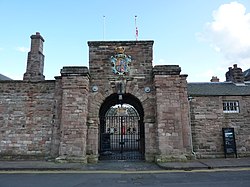
Berwick Barracks
Berwick Barracks, sometimes known as Ravensdowne Barracks, is a former military installation of the British Army in Berwick-upon-Tweed, England.
Nearby Places View Menu

99 m
Church of the Holy Trinity, Berwick-on-Tweed
The Church of the Holy Trinity, Berwick-on-Tweed is a Church of England parish church in the centre of Berwick-upon-Tweed, Northumberland. It is a rare example of a church built in the Commonwealth era.

139 m
Shaws Lane Chapel
Shaws Lane Relief Chapel in Berwick upon Tweed was founded in 1756 by a Presbyterian group seceding from the Low Meeting House in Hide Hill. The Congregation were of the Church of Scotland but preferred to choose their own Minister and so they pooled what money they had or could raise in order to fund its construction. The Relief Capel is situated between the High Street and Shaws Lane near the eastern extremity of Shaws Lane.
142 m
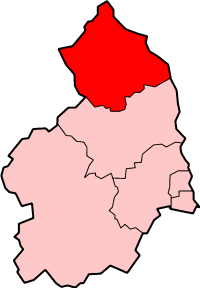
Borough of Berwick-upon-Tweed
Berwick-upon-Tweed was a local government district and borough in Northumberland in the north-east of England, on the border with Scotland. The district had a resident population of 25,949 according to the 2001 census, which also notes that it is the most ethnically homogeneous in the country, with 99.6% of the population recording themselves in the 2001 census as White. It was also the least populated district in England with borough status, and the third-least densely populated local government district (after Eden and Tynedale).
Its main town is Berwick-upon-Tweed, sited immediately to the north of the Tweed estuary. The town is ancient, the scene of a number of battles; it has perhaps the best remaining example of a (almost completely intact) town wall, built for defensive purposes.
On the south of the estuary, the port of Tweedmouth is the point of export of diverse goods, but especially grain and roadstone. The remainder of the borough is rural, bordered to the west by the Cheviot Hills, and to the east by a scenic coastline.
The borough was formed on 1 April 1974 by the merger of the previous borough of Berwick-upon-Tweed with Belford Rural District, Glendale Rural District and Norham and Islandshires Rural District.
Berwick was the first district in Britain to hold a referendum on whether to have a directly elected mayor. This referendum, on 7 June 2001, decided against an elected mayor.
The district was abolished as part of the 2009 structural changes to local government in England effective from 1 April 2009 with responsibilities being transferred to Northumberland County Council, a unitary authority.

199 m
Our Lady and St Cuthbert Church, Berwick
Our Lady and St Cuthbert Church is a Roman Catholic parish church in Berwick-upon-Tweed, Northumberland, England. It was built in 1829 in the Gothic Revival style, intentionally hidden away from the street. It is located on Ravensdowne to the south of Berwick Barracks in the centre of the town. It is a Grade II listed building.