Nook Colliery was a coal mine operating on the Manchester Coalfield after 1866 in Tyldesley, Greater Manchester, then in the historic county of Lancashire, England. The colliery's first shaft was sunk to the Rams mine at 455 yards in 1866 by Astley and Tyldesley Coal and Salt Company to exploit the Middle Coal Measures of the Manchester Coalfield. The colliery expanded and eventually had five shafts and became one of the largest pits on the coalfield. No.2 upcast shaft was sunk in 1873 and deepened to the Arley mine, a hot mine where temperatures reached 100 Fahrenheit, at 935 yards. No.3 shaft was sunk to 707 yards to the Trencherbone mine through water-bearing rock in 1899. No.4 shaft, sunk in 1913, intersected every workable coal seam. The colliery had two horizontal winding engines. The colliery became part of Manchester Collieries in 1929 and the National Coal Board in 1947. In 1954, 1000 men were employed producing 440,000 tons of coal per annum. After closure most colliery buildings were demolished and the site landscaped. The pithead bath house built by the Miner's Welfare Committee in the 1930s survived and was converted to other uses. The pit was the subject of a painting by local artist, Roger Hampson.

Nearby Places View Menu
434 m

Gin Pit Colliery

Gin Pit was a coal mine operating on the Lancashire Coalfield from the 1840s in Tyldesley, Greater Manchester then in the historic county of Lancashire, England. It exploited the Middle Coal Measures of the Manchester Coalfield and was situated to the south of the Tyldesley Loopline.
554 m

St George's Colliery

St George's Colliery, Back o't' Church, was a coal mine operating on the Manchester Coalfield after 1866 in Tyldesley, Greater Manchester, then in the historic county of Lancashire, England. It was owned by Sir Edmund Buckley. The colliery was situated to the south of Tyldesley Station on the Tyldesley Loopline and named after St George's Church. The colliery's two shafts were sunk to the Rams mine commencing in 1866 by Astley and Tyldesley Coal and Salt Company to exploit the Middle Coal Measures of the Manchester Coalfield. The colliery was linked to Gin Pit Colliery for ventilation. A third shaft to the Trencherbone mine was sunk in 1884 and was deepened to the Arley mine. The colliery worked the Seven Foot until 1929. The colliery became part of Manchester Collieries in 1929 ceased coal production in 1941 but retained for ventilation purposes until 1964.
Location Image
571 m

Tyldesley railway station

Tyldesley railway station is a closed railway station in Greater Manchester. It was situated within the historic county of Lancashire.
Location Image
702 m

St George's Church, Tyldesley

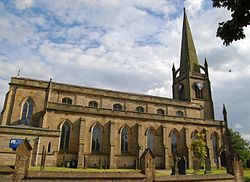
St George's Church is an Anglican parish church serving Tyldesley and Shakerley in Greater Manchester, England. It is part of Leigh deanery in the archdeaconry of Salford and the diocese of Manchester. The church, together with St Stephen's Church, Astley and St John's Church, Mosley Common is part of the united benefice of Astley, Tyldesley and Mosley Common. A Waterloo Church, it was founded as a chapel of ease of the parish church in Leigh in 1825, in a rapidly expanding township. A mistake with plans led to a larger church than the site could accommodate and extra land and money was donated to ensure the church could be completed. The church was extended at the east end and re-seated in the 1880s and has survived two fires. The churchyard contains the graves of victims of a disaster at Yew Tree Colliery. In 1966 the church was designated a Grade II listed building.