The Radical Civic Union (Spanish: Unión Cívica Radical, UCR) is a major political party in Argentina. It has reached the national government on ten occasions, making it one of the most historically important parties in the country. Ideologically, the party has stood for radicalism, secularism and universal suffrage. Especially during the 1970s and 1980s, it was perceived as a strong advocate for human rights. Its factions however, have been more heterogeneous, ranging from conservative liberalism to social democracy. Founded in 1891 by Leandro N. Alem, it is the second oldest political party active in Argentina. The party's main support has long come from the middle class. On many occasions, the UCR was in opposition to Peronist governments and declared illegal during military rule. Since 1995 it has been a member of the Socialist International (an international organisation of social democrat political parties). The UCR had different fractures, conformations, incarnations and factions, through which the party ruled the country seven times with the presidencies of Hipólito Yrigoyen (1916-1922 and 1928-1930), Marcelo Torcuato de Alvear (1922-1928), Arturo Frondizi (1958-1962), Arturo Illia (1963-1966), Raúl Alfonsín (1983-1989) and Fernando de la Rúa (1999-2001). After 2001, the party has been particularly fragmented. As the Justicialist Party led by Nestor and Cristina Kirchner moved to the left, the UCR aligned itself with anti-Peronist centre-right parties. From 2015 to 2023, the UCR was a member of the centre-right Cambiemos / Juntos por el Cambio coalition, along with Republican Proposal and Civic Coalition ARI, and supported Mauricio Macri in the 2015 and 2019 presidential elections. For the 2023 elections, the party supported the candidacy of Patricia Bullrich. The party is not currently in any coalition since Juntos por el Cambio's dissolution in 2023.

Nearby Places View Menu
Location Image
135 m

Argentine Senate

The Chamber of Senators of the Argentine Nation (Spanish: Cámara de Senadores de la Nación Argentina) or Senate, officially the Honorable Chamber of Senators of the Argentine Nation (Spanish: Honorable Cámara de Senadores de la Nación Argentina) is the upper house of the National Congress of Argentina.
Location Image
249 m

Argentine Chamber of Deputies

The Chamber of Deputies (Spanish: Cámara de Diputados de la Nación), officially the Honorable Chamber of Deputies of the Argentine Nation, is the lower house of the Argentine National Congress (Spanish: Congreso de la Nación). It is made up of 257 national deputies who are elected in multi-member constituencies corresponding with the territories of the 23 provinces of Argentina (plus the Federal Capital) by party list proportional representation. Elections to the Chamber are held every two years, so that half of its members are up in each election, making it a rare example of staggered elections used in a lower house. The Constitution of Argentina lays out certain attributions that are unique to the Chamber of Deputies. The Chamber holds exclusive rights to levy taxes; to draft troops; and to accuse the president, cabinet ministers, and members of the Supreme Court before the Chamber of Senators. Additionally, the Chamber of Deputies receives for consideration bills presented by popular initiative. The Chamber of Deputies is presided over by the president of the Chamber (Spanish: Presidente de la Cámara), who is deputized by three vice presidents. All of them are elected by the chamber itself.
Location Image
249 m

Argentine National Congress

The National Congress of Argentina (Spanish: Congreso de la Nación Argentina) is the legislative branch of the government of Argentina. Its composition is bicameral, constituted by a 72-seat Senate and a 257-seat Chamber of Deputies. The Senate, a third of whose members are elected to six-year renewable terms every two years, consists of three representatives from each province and the federal capital. The Chamber of Deputies, whose members are elected to four-year terms, is apportioned according to population, and renews their members by a half each two years. The Congressional Palace is located in Buenos Aires, at the western end of Avenida de Mayo (at the other end of which is located the Casa Rosada). The Kilometre Zero for all Argentine National Highways is marked on a milestone at the Congressional Plaza, next to the building.
Location Image
249 m

Palace of the Argentine National Congress

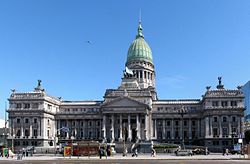
The Palace of the Argentine National Congress (Spanish: Palacio del Congreso de la Nación Argentina, often referred locally as Palacio del Congreso or simply Congreso) is a monumental building, seat of the Argentine National Congress, located in the city of Buenos Aires. It is located in the barrio of Balvanera at its limit with Monserrat, an area informally known as the Congreso neighbourhood. Constructed between 1898 and 1906, the palace is a National Historic Landmark. The Kilometre Zero for all Argentine National Highways is marked on a milestone at the Congressional Plaza, next to the building.