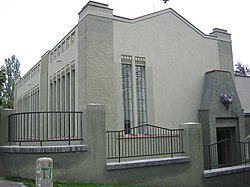
Vinohrady Water Tower (Czech: Vinohradská vodárna) is a building in Vinohrady in Prague 10 which was originally built as a water tower. Today its architecture is recognized as culturally important although it is now converted to accommodate offices and apartments. The viewing platform at the top is 40 metres above the street level. Its tourism helps pay for over 20,000 dollars' worth of repairs and maintenance a year.

1. History

The Vinohrady water tower building was created in 1882 to house steam engines and an underground reservoir. The engines pumped water up from the reservoir, creating a gravitational feed to nearby homes and businesses. Antonin Turek designed the building while he was the municipal architect. The seventh floor originally contained a tank that could hold 200 cubic metres of water. Initially this was pumped from the River Vltava until 1912, when the water source was switched to a plant at Káraný. The water descended from the tank to supply Strašnice, Žižkov and Vršovice with drinking water. In 1914 the tower's steam engines were replaced with electric motors. The revised system used water that was treated at a plant at Podolí and then stored in water tanks underground before being pumped to the top of this tower for use.

1. Architecture

Today its architecture is acknowledged to be of national historical importance, even though the building serves no modern purpose for water supply, as the motors, pumps and pipes have been removed. In 1993, the inside was converted to accommodate offices and apartments. The viewing platform at the top is 40 metres above the street level – once this provided a commanding view of the area, but today it is only slightly taller than the tenements that surround the tower. On each corner there are the statues of angels with clock faces between them. Below the clocks are four medallions celebrating Vinohrady. In 1991 the tower was recognised as being of cultural importance and was listed by the Czech Ministry of Culture.

1. References
Nearby Places View Menu
Location Image
96 m

Hus Congregational House

The Hus Congregational House, or Husův sbor, is a Hussite church in Dykova Street in Prague 10. It was completed in 1935 as part of a multi-functional development by architect Pavel Janák in the constructivist style. The tall, six-storey minimalist tower and belfry carries a 700 kg copper chalice as a symbol of the Hussite Church. The tower was briefly used to create an alternative radio station during the Prague uprising in 1945.
Location Image
236 m

Vinohrady

Vinohrady (until 1960 Královské Vinohrady, in English literally "Royal Vineyards" German: Königliche Weinberge) is a cadastral district in Prague. It is so named because the area was once covered in vineyards dating from the 14th century. Vinohrady lies in the municipal and administrative districts of Prague 2 (west part), Prague 3 (north-east part) and Prague 10 (south-east part), little parts also of Prague 1 (Prague State Opera and Federal Assembly of Czechoslovakia) and Prague 4 (near Nusle). Between 1788–1867 it was called Viničné Hory (Vineyard Mountains). From 1867 to 1968 it was called Královské Vinohrady ("Royal Vineyards"). In 1875, Královské Vinohrady was divided into two parts, Královské Vinohrady I and Královské Vinohrady II, the part I was renamed to Žižkov and the part II to Královské Vinohrady in 1877. In 1922 Královské Vinohrady was made part of Prague as district XII. In 1949, the west part was conjoined with Prague 2 and the east part remain separate district Prague 12. In 1960, when Prague's divisions were reduced from 16 to 10 administrative districts, the north part of Prague 12 was conjoined with Žižkov into Prague 3 and the south part was joined to Prague 10. Local patriots say that the real reason was that Královské Vinohrady was known as a "bourgeois" district and thus politically unreliable for the then-ruling Communist Party of Czechoslovakia. The historic part of Prague Main Railway Station (open 1871 as Franz Joseph I Station) is situated at the margin of Vinohrady. City Electric Tramway of Královské Vinohrady (1897) were a base of the Prague net of municipal electric tramway.
Location Image
300 m

Šaloun Villa

Šaloun Villa (Czech: Šalounova vila) is a studio in Prague designed by and for the sculptor Ladislav Šaloun. The villa was designed and built to construct the Jan Hus Memorial but it was also a meeting place for the Czech intelligentsia. Today the building has been restored and it is used for education.
Location Image
305 m

Jiřího z Poděbrad (Prague Metro)

Jiřího z Poděbrad (Czech pronunciation: [ˈjɪr̝iːɦo ˈspoɟɛbrat]) is a Prague Metro station on Line A, located in Vinohrady, Prague 3. In January 2023 it closed for reconstruction.