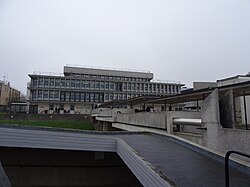
Hull Road Park is a 25-acre (10 ha) open-space park in the suburb of Tang Hall, York, in Northern England. The park is bordered on its southern edge by Osbaldwick Beck, which has become a home for the endangered water vole. The City of York Council withdrew support for the park in 2011, and it is maintained and cleaned by a network of volunteers working for several different societies.

1. History

The park was opened in 1927 in the Tang Hall area of York, and is bordered by housing to the north, Tang Hall Lane to the east, Melrosegate to the west, and Osbaldwick Beck to the south. The beck, which flows from east to west (and feeds into the River Foss) has been canalised during the park's history and has several weirs. After a seven-year remedial work programme on Osbaldwick Beck and its banks, it was confirmed in August 2024 that the red-list endangered water vole, had taken up residence on the beck through the park. Students from University of York helped in this effort by creating a bog garden along the banks of the beck in 2023. The course of the beck is prone to floods, which can overwhelm the roads on the western side of the park. In 2017, the city council provided £60,000 for a re-naturalisation scheme to help alleviate flooding. The area has been affected by flooding from Osbaldwick Beck and Tang hall Beck in 1947, 1982, 2000 and the Boxing Day floods of 2015. Budgetary restraints in 2011 led to the City of York Council withdrawing attendants from the park, and flowerbeds being converted to public open spaces in an effort to save money. Several local volunteer groups now maintain parts of the park with access to council funding.

1. Facilities and transport

The park covers an area of 25 acres (10 ha) and has basketball courts, tennis courts, a playpark, and large areas of semi-natural woodland. The park also used to have formal gardens and a bowling green, with a resident bowling team. The No. 6 bus between Clifton Moor and Heslington calls at a stop opposite the park every twenty minutes during the day.

1. References


1. External links

Hull Road Park on York City Council website

Nearby Places View Menu
Location Image
614 m

Siward's Howe

Siward's Howe, sometimes written Siwards How and also known as Heslington Hill or Bunny Hill, is a terminal moraine located to the south-east of the city of York. The howe is situated north west of the Morrell Library building of the University of York. The southern side of the howe is part of Alcuin College of the University of York. Its imposing water tower is visible from many parts of the nearby suburbs of Tang Hall and Osbaldwick. Howe, when derived from the Old Norse: haugr, means hill, knoll, or mound and may refer to a tumulus, or barrow. Siward's Howe is named for Siward, Earl of Northumbria, the 11th-century Danish warrior. He was romanticised in the William Shakespeare play, Macbeth. Siward died at York during 1055 and is rumoured to have been buried beneath the tumuli at the wooded summit.
Location Image
646 m

The Retreat

The Retreat, commonly known as the York Retreat, is a place in England for the treatment of people with mental health needs. Located in Lamel Hill in York, it operates as a not for profit charitable organisation. Opened in 1796, it is famous for having pioneered the so-called "moral treatment" that became a behaviour model for asylums around the world with mental health issues. Founded by William Tuke, it was originally only for Quakers but gradually became open to everyone. It inspired other progressive facilities such as the US Brattleboro Retreat, Hartford Retreat and Friends Hospital. The present day The Retreat seeks to retain the essence of early "moral treatment", while applying the principles to a modern healthcare setting. The Retreat withdrew from the delivery of inpatient services after 222 years on 31 December 2018.
Location Image
663 m

Lawrence Street (York)

Lawrence Street is a road in York, in England, immediately south-east of the city centre.
Location Image
667 m

University of York Library

The University of York Library is the library service for students and staff at the University of York, England. The current library physical premises comprise a series of three linked buildings to the north side of the University of York Heslington West campus. The buildings are also home to the Borthwick Institute for Archives. Since the library's inception its collections have grown to encompass more than a million items, including books, journals, music scores, theses and dissertations, and digital media. The Library is part of Library, Archives and Learning Services, which employs 168 staff, and which is in turn part of Student and Academic Services at the University of York.