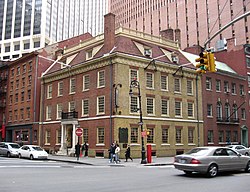
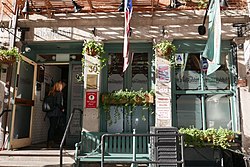
Fraunces Tavern, en français "la Taverne Fraunces", est un restaurant et un musée du sud de l'arrondissement de Manhattan à New York. Frances Tavern a la réputation d'être le plus vieil immeuble de New York. Cette caractéristique est néanmoins contestée. Beaucoup estiment que le bâtiment actuel n'a presque plus rien d'authentique, en raison des nombreuses restaurations et reconstructions qu'il a connues au fil des siècles. Il n'en reste pas moins que Fraunces Tavern est un lieu important dans l'histoire de la ville.

1. Histoire

En 1700, le Colonel Stephanus Van Cortlandt donna sa propriété, qu'il avait bâtie en 1671, à son gendre, Stephen DeLancey (Étienne de Lancy, un Huguenot normand émigré à New York). DeLancey entama la construction du bâtiment originel en 1719. Les héritiers de DeLancey vendirent la demeure à Samuel Fraunces en 1762, qui en fit une taverne populaire, où se réunissaient notamment les Fils de la Liberté. Après que les Américains obtinrent leur indépendance, George Washington y fit ses adieux à ses officiers, en 1783. La taverne a continué de fonctionner au XIXe siècle, mais subit plusieurs incendies en 1832. Après plusieurs reconstructions, la structure avait changé d'apparence, au point qu'on ignore sa configuration originelle.

1. La reconstruction

En 1900, les propriétaires de Fraunces Tavern envisagèrent de raser le bâtiment. De nombreuses associations, dont les Filles de la Révolution se sont mobilisées pour préserver cette construction. Grâce à cela, une importante reconstruction put être mise en place en 1907.

1. L'attentat de 1975

Le 24 janvier 1975, une bombe posée par un groupe de nationalistes porto-ricains, Les Fuerzas Armadas de Liberación Nacional, explosa dans l'immeuble. L'attentat coûta la vie à quatre personnes.

1. Fraunces Tavern aujourd'hui

Aujourd'hui, Fraunces Tavern est un site touristique qui abrite un restaurant et un musée.

1. Au cinéma

Dans le film l'Amour sans préavis (2002), une scène est tournée à l'intérieur du restaurant, et également à l'extérieur. La scène est jouée par Hugh Grant et Sandra Bullock. Leurs personnages déjeunent devant la cheminée.

1. Références


1. Liens externes

Ressource relative à l'architecture : Registre national des lieux historiques (en) Le musée de Fraunces Tavern (en) Le restaurant de Fraunces Tavern Portail du Registre national des lieux historiques Portail de New York

Nearby Places View Menu
Location Image
10 m

Fraunces Tavern

Fraunces Tavern is a museum, bar and restaurant in New York City, situated at 54 Pearl Street at the corner of Broad Street in the Financial District of Lower Manhattan. The location played a prominent role in history before, during, and after the American Revolution. Fraunces Tavern served as a meeting place for the Sons of Liberty, a venue for peace negotiations with the British, and housing for federal offices of the early republic. Fraunces Tavern has been owned since 1904 by Sons of the Revolution in the State of New York Inc., which carried out a meticulous restoration to the oldest surviving building in Manhattan. A museum on the premises interprets the building and its history, along with varied exhibitions of art and artifacts. The tavern is a tourist site and a part of the American Whiskey Trail and the New York Freedom Trail. It is listed on the National Register of Historic Places and is a New York City designated landmark. In addition, the block on which Fraunces Tavern is located is a National Historic Landmark District and a New York City designated landmark district.
Location Image
29 m

The Dead Rabbit

The Dead Rabbit, also known as The Dead Rabbit Grocery and Grog, is a craft cocktail bar in the Financial District of Manhattan, New York City. The bar was founded in 2013 in its location on Water Street. It opened as a "cocktail emporium", evoking the drinking habits of 19th-century New Yorkers. The bar's name is a reference to the Dead Rabbits, an Irish American street gang active in Lower Manhattan in the 1830s to 1850s. The establishment was rated the best bar in the world in 2016, as compiled by The World's 50 Best Bars. It was also named world's best bar at the Tales of the Cocktail competition. In 2022, the bar announced plans to open locations in New Orleans and Austin, Texas, as well as a sister bar in Charleston. One of the bar's owners will work with its beverage director to establish the Charleston bar, while still remaining a silent partner at The Dead Rabbit. A new beverage director would be named for The Dead Rabbit bar. The bar is in the Fraunces Tavern Block Historic District, a National Historic Landmark District and a New York City designated landmark district. The establishment has three stories, including a ground-floor taproom with basic drinks, a second-floor parlor with craft cocktails, and a third-floor, private room for parties.
Location Image
65 m

Coenties Slip

Coenties Slip is a street in the Financial District of Manhattan in New York City. It runs southeast for two blocks in Lower Manhattan from Pearl Street to South Street. A walkway runs an additional block north from Pearl Street to Stone Street. The slip was originally an artificial inlet in the East River for the loading and unloading of ships that was land-filled in 1835. The entire length of the road is a pedestrian street, though before 2013, the block north of Water Street carried vehicular traffic.
Location Image
70 m

25 Water Street

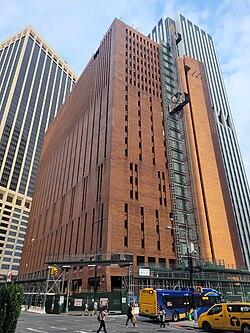
25 Water Street, also known as 4 New York Plaza, is a building at Water Street and Broad Street the Financial District of Manhattan in New York City, U.S. It directly adjoins both 125 Broad Street to the south, which is connected, and the Vietnam Veterans Plaza to the east. The building was completed in 1969 and operated as an office building from 1969 to 2022. In 2023 it began a process of redevelopment into a residential building that will have over 1,300 apartments, the largest such office-to-residential property conversion in the United States.
81 m

Stadt Huys Site

The Stadt Huys (an old Dutch spelling, meaning city hall) was the first city hall in New York City, New York. It was built in 1642 by the Dutch, when the settlement was named New Amsterdam. The building was used until 1697, when the structure was no longer deemed safe for occupants. The structure was located at present 71 Pearl Street (now demolished) in the modern-day Financial District of Lower Manhattan. The Stadt Huys block archaeology project took place in 1979–1980 and was New York City's first large-scale archaeological excavation. At the time, it was one of the most expensive and most productive projects of urban archeology undertaken in an American city. Many logistical procedures for urban archaeology had to be developed as the project evolved. Most of these procedures have become a model for performing large-scale excavations in the city.