
Location Image

Orpheum Theatre (San Francisco)

The Orpheum Theatre, originally the Pantages Theatre, is located at 1192 Market Street at Hyde, Grove and 8th Streets in the Civic Center district of San Francisco, California. The theatre first opened in 1926 as one of the many designed by architect B. Marcus Priteca for theater-circuit owner Alexander Pantages. The interior features a vaulted ceiling, while the facade is a Plateresque (Late Spanish Gothic) Revival. The Orpheum seats 2,197 patrons. In 1998, after a previous renovation in the 1970s, a $20 million renovation was completed to make the Orpheum more suitable for Broadway shows. The theatre is a locally designated San Francisco landmark as determined by the San Francisco Landmarks Preservation Advisory Board. The Orpheum, as well as the Golden Gate Theatre in San Francisco, are owned by BroadwaySF.

1. History

In April 1998 the Kern/Hammerstein musical "Show Boat" was the first production staged in the reconstructed and expanded theater. The theater has hosted numerous Broadway shows, including a two-year sit-down production of the musical Wicked from January 27, 2009, through September 2010. The Grateful Dead gave six performances here on July 12–18, 1976. From April 30 to May 4, 2007, the theatre hosted Late Night with Conan O'Brien. Productions that were staged at the Orpheum prior to opening on Broadway have included Bring It On: The Musical (2011–2012)[1], Evita (1979)[2], Mamma Mia! (2000–2001), and The Act (1977)[3].

1. Gallery


1. References


1. External links

BroadwaySF, owner of the Orpheum

Nearby Places View Menu
Location Image
112 m

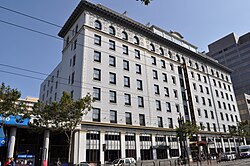
Hotel Whitcomb

The Hotel Whitcomb is a San Francisco hotel that was built from 1911 to 1912. Located at 1231 Market Street, the Whitcomb opened in 1912 as San Francisco's temporary city hall and then reopened in 1917 as a 400-room hotel.
Location Image
125 m

United Nations Plaza (San Francisco)

United Nations Plaza (often abbreviated UN Plaza or UNP) is a 2.6-acre (1.1 ha) plaza located on the former alignments of Fulton and Leavenworth Streets—in the block bounded by Market, Hyde, McAllister, and 7th Street—in the Civic Center of San Francisco, California. It is located 1⁄4 mi (0.40 km) east of City Hall and is connected to it by the Fulton Mall and Civic Center Plaza. Public transit access is provided by the BART and Muni Metro stops at the Civic Center/UN Plaza station, which has a station entrance within the plaza itself. UN Plaza was designed by a joint venture of firms led by the noted architects Lawrence Halprin, John Carl Warnecke, and Mario Ciampi; Halprin designed the large sunken fountain. The plaza was dedicated in 1975 to commemorate the formation of the United Nations and the signing of the Charter of the United Nations on 26 June 1945 in San Francisco. Since its dedication, the plaza was refurbished in 1995 and 2005, and in Spring 2018, three redesign proposals were proposed for public review.
Location Image
129 m

Pioneer Monument (San Francisco)

The Pioneer Monument is a granite monument supporting bronze figures and reliefs created by Frank Happersberger and financed by the estate of James Lick. It is located on Fulton Street between Hyde and Larkin streets in the Civic Center of San Francisco, California, next to the San Francisco Public Library. It was dedicated on November 29, 1894. A highly controversial component, Early Days, was removed in 2018.
Location Image
130 m

Statue of Ashurbanipal (San Francisco)

Ashurbanipal, also known as the Ashurbanipal Monument or the Statue of Ashurbanipal, is a bronze sculpture by Fred Parhad, an artist of Assyrian descent. It is located in the Civic Center of San Francisco, California, in the United States. The 15-foot (4.6 m) statue depicting the Assyrian king of the same name was commissioned by the Assyrian Foundation for the Arts and presented to the City of San Francisco in 1988 as a gift from the Assyrian people. The sculpture reportedly cost $100,000 and was the first "sizable" bronze statue of Ashurbanipal. It is administered by the City and County of San Francisco and the San Francisco Arts Commission. Parhad's work was met with some criticism by local Assyrians, who argued it was inaccurate to portray Ashurbanipal holding a clay tablet and a lion, or wearing a skirt. The critics thought the statue looked more like the Sumerian king Gilgamesh; Maureen Gallery Kovacs, a Yale Ph.D. who has translated The Epic of Gilgamesh (Stanford U.P., 1989), believed the sculpture depicted neither figure, but rather a Mesopotamian "protective figure". Parhad defended the accuracy of his work, while also admitting that he took artistic liberties.