

 English
 Français

Shaw and Crompton tram stop
Shaw and Crompton is a tram stop on the Oldham and Rochdale Line (ORL) of Greater Manchester's light-rail Metrolink system. It opened to passengers on 16 December 2012 and is located in Shaw and Crompton, a part of the Metropolitan Borough of Oldham, England. The station sits adjacent to the site of the original Shaw and Crompton railway station, a regional rail station which opened (initially for haulage) on 2 November 1863 and closed on 3 October 2009 for conversion to Metrolink. Known as Shaw railway station between 1974 and 1989, it was along the Oldham Loop Line, which operated from Manchester to Rochdale via Oldham and thus was almost identical to the current Metrolink route.
Nearby Places View Menu
183 m
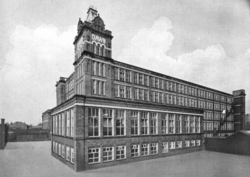
Dawn Mill, Shaw
Dawn Mill, Shaw was a cotton spinning mill in Shaw and Crompton, Oldham, Greater Manchester. It was built on the site of Shaw Mill at the "dawn" of the 20th century. Dawn Mill was equipped with mule weft spindles in 1950. It was powered by Engines named Venus and Mars, 1800 hp twin tandem compound engine by George Saxon of Manchester. It was taken over by the Lancashire Cotton Corporation in the 1930s and passed to Courtaulds in 1964. It was sold again and used by distribution company DTS Logistics for storing and distributing clothing. It was demolished in 2006 to make way for an Asda supermarket.

187 m
Shaw and Crompton
Shaw and Crompton is a civil parish in the Metropolitan Borough of Oldham, Greater Manchester, England, and lies on the River Beal at the foothills of the South Pennines. It is located 2 miles (3.2 km) north of Oldham, 4 miles (6.4 km) south-east of Rochdale and 9 miles (14 km) north-east of Manchester. Its largest settlement is Shaw.
Historically in Lancashire, the area shows evidence of ancient British and Anglian activity. In the Middle Ages, Crompton formed a small township of scattered woods, farmsteads, moorland and swamp. The local lordship was weak or absent, and so Crompton failed to emerge as a manor with its own lord and court. Farming was the main industry of this rural area, with locals supplementing their incomes by hand-loom woollen weaving in the domestic system.
The introduction of textile manufacture during the Industrial Revolution initiated a process of rapid and unplanned urbanisation. A building boom began in Crompton in the mid-19th century, when suitable land for factories in Oldham was becoming scarce. By the late 19th century, Crompton had emerged as a densely populated mill town with forty-eight cotton mills, some of the largest in the United Kingdom, in the area. At its spinning zenith, as a result of an interwar economic boom and the over-valuation of shares associated with the textile industry, Shaw and Crompton had more millionaires per capita than any other town in the world. Imports of foreign cotton goods saw a decline in the textile industry by the mid-20th century and the last mill closed in 1989.
Shaw and Crompton covers 4.5 square miles (11.7 km2) and is a predominantly suburban area of mixed affluence with a population of 21,065 as of 2011. The legacy of its industrial past can be seen in its three surviving cotton mills, all of which are home to large distribution companies, among them is Yodel based at Shaw National Distribution Centre, a major employer in the area.

437 m
Shaw, Greater Manchester
Shaw is a ward and part of the built-up area in the civil parish of Shaw and Crompton, in the Oldham district, in the county of Greater Manchester, England. It is about 9 miles from Manchester city centre. In 2021 the built-up area of Shaw and Crompton had a population of 18,245. In 2021 the ward had a population of 10,045. Until 1974 it was in Lancashire.

441 m
Crompton War Memorial
Crompton War Memorial is a Grade II* listed monument in the Memorial Gardens on High Street in Shaw and Crompton, a civil parish within the Metropolitan Borough of Oldham, Greater Manchester, England. It was unveiled on 29 April 1923 by General Sir Ian Hamilton to commemorate those who had fallen in the First World War, and was later updated to include those who died during the Second World War.