

 English
 Français
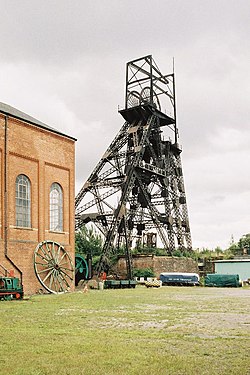
Musée de la mine d'Astley Green
Le musée d'Astley Green Colliery est un musée géré par la Red Rose Steam Society, situé à Astley, près de Tyldesley, dans le Grand Manchester, Angleterre, au Royaume-Uni. Avant de devenir un musée, le site était une mine de charbon en activité qui produisait du charbon de 1912 à 1970 ; il est maintenant protégé en tant que Monument historique. Le musée occupe un site de 15 acres (6 ha) le long du canal de Bridgewater, qui abrite le seul chevalement et la salle des machines encore existants sur le bassin houiller du Lancashire.
Nearby Places View Menu
0 m
Astley Green Colliery Museum
The Astley Green Colliery Museum is a heritage museum in Astley near Tyldesley in Greater Manchester, England, operated by the Red Rose Steam Society. The site was originally a working colliery that produced coal from 1912 until its closure in 1970 and is now protected as a Scheduled Monument. The museum occupies a 15-acre (6 ha) site beside the Bridgewater Canal and contains the only surviving pit headgear and engine house on the Lancashire Coalfield.

39 m
Astley Green Colliery
Astley Green Colliery was a coal mine in Astley, Greater Manchester, then in the historic county of Lancashire, England. It was the last colliery to be sunk in Astley. Sinking commenced in 1908 by the Pilkington Colliery Company, a subsidiary of the Clifton and Kersley Coal Company, at the southern edge of the Manchester Coalfield, working the Middle Coal Measures where they
dipped under the Permian age rocks under Chat Moss. The colliery was north of the Bridgewater Canal. In 1929 it became part of Manchester Collieries, and in 1947 was nationalised and integrated into the National Coal Board. It closed in 1970, and is now Astley Green Colliery Museum.
616 m
Leigh Rural District
Leigh Rural District was, from 1894 to 1933, a rural district of the administrative county of Lancashire, in northwest England. It spanned a rural area outlying from the town Leigh.
It was created based on the rural sanitary district and consisted of the civil parishes of Astley, Culcheth, Kenyon and Lowton. The district was abolished in 1933 under a County Review Order. The parishes of Kenyon, Lowton and part of Culcheth went to the Golborne urban district, Astley was added to Tyldesley Urban District, and the remainder of Culcheth parish became part of the parish of Croft in Warrington Rural District.
Since 1974 the parishes of Croft and Culcheth and Glazebury form part of the borough of Warrington and the rest are part of the Metropolitan Borough of Wigan.

624 m
Astley, Greater Manchester
Astley is a village in the Metropolitan Borough of Wigan, Greater Manchester, England. Within the boundaries of the historic county of Lancashire, it is crossed by the Bridgewater Canal and the A580 East Lancashire Road. Continuous with Tyldesley, it is between Wigan and Manchester, both 8 miles (13 km) away. Astley Mosley Common ward had a population of 11,270 at the 2011 Census.
Astley's name is Old English, indicating Anglo-Saxon settlement. It means either "east (of) Leigh", or ēastlēah the "eastern wood or clearing". Throughout the Middle Ages, Astley constituted a township within the parish of Leigh and hundred of West Derby. Astley appears in written form as Asteleghe in 1210, when its lord of the manor granted land to the religious order of Premonstratensian canons at Cockersand Abbey.
Medieval and Early Modern Astley is distinguished by the dignitaries who occupied Damhouse, the local manor house around which a settlement expanded. The Bridgewater Canal reached Astley in 1795, and the Liverpool and Manchester Railway in 1830. The Industrial Revolution introduced the factory system when the village's cotton mill was built in 1833. Coal mining became an important industry.
Mining subsidence and a decline in coal production led to a reduction in the industry in the mid-20th century; its cotton mill closed in 1955, and the last coal was brought to the surface in 1970. Astley Green Colliery Museum houses collections of Astley's industrial heritage.

856 m
St Stephen's Church, Astley
St Stephen's Church is a parish church located in Astley, Greater Manchester, England. It is an active Anglican church built in 1968, and it is part of the Leigh deanery in the archdeaconry of Salford diocese of Manchester. Along with St George's Church, Tyldesley, and St John's Church, Mosley Common St Stephen's forms part of the united benefice of Astley, Tyldesley and Mosley Common.
The origins of St Stephen's Church date back to Astley Chapel, a chapel of ease of Leigh Parish Church built in 1631 and its successor which was burned in an arson attack in 1961.