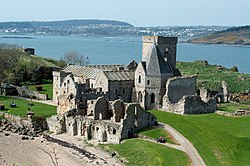
Inchcolm (écossais : Innis Choluim - "Île de Columba") est une île située sur le Firth of Forth, à l'est du Forth Bridge, au sud d'Aberdour (région de Fife), et au nord d'Édimbourg, en Écosse. L'intérêt principal de cette île réside dans l'abbaye augustine d'Incholm qui s'y dresse et qui constitue l'exemple de construction monastique le plus remarquablement conservé d'Écosse. Autrefois et sans doute en raison de sa dédicace à Colomba, on la surnommait parfois « Iona de l'est ». L'île abrite un monument de pierre dénommé hogback (conservé avec d'autres ouvrages de pierre dans le centre de visite de l'abbaye), qui pourrait être le plus ancien (fin du Xe siècle ?) monument remontant à l'époque des colons danois du nord de l'Angleterre. Selon une source médiévale, ce monument était jadis surmonté d'une croix. L'île peut être divisée en trois parties : la partie orientale, où des opérations de défense étaient organisées lors de la Seconde Guerre mondiale, la partie basse de l'île, située au centre, abritant un petit port naturel et des boutiques, et la grande partie occidentale, habitat d'une vaste colonie de mouettes et de fulmars. On trouve régulièrement des phoques sur les rochers affleurant sur les côtes de l'île.

Lieux à Proximité Voir Menu
Location Image
0 m

Inchcolm

Inchcolm (from Scottish Gaelic Innis Choluim 'Columba's Island') is an island in the Firth of Forth in Scotland. The island has a long history as a site of religious worship, having started with a church, which later developed into a monastery and a large Augustine Abbey in the mid 13th century. It was repeatedly attacked by English raiders during the Wars of Scottish Independence, and was later fortified extensively with gun emplacements and other military facilities during both World Wars to defend nearby Edinburgh. Inchcolm Abbey and the surrounding island are now in the care of Historic Scotland. The island is accessible to visitors during the day via private boat tours from Queensferry. Many of the religious buildings on Inchcolm remain in fair condition and Inchcolm is described as having the best-preserved cloister in Scotland.
Location Image
152 m

Inchcolm Abbey

Inchcolm Abbey is a medieval abbey located on the island of Inchcolm in the Firth of Forth in Scotland. The Abbey, which is located at the centre of the island, was founded in the 12th century during the episcopate of Gregoir, Bishop of Dunkeld. Later tradition placed it even earlier, in the reign of King Alexander I of Scotland (1107–24), who had taken shelter on Incholm when his ship was forced ashore during a storm in 1123. It is said he resided there for three days with the Hermit of Incholm. The Abbey was first used as a priory by Augustinian canons regular, becoming a full abbey in 1235. The island was attacked by the English from 1296 onwards, and the Abbey was abandoned as a result of the Scottish Reformation in 1560. It has since been used for defensive purposes, as it is situated in a strategically important position in the middle of the Firth of Forth. A Latin inscription carved above the Abbey's entrance reads: Stet domus haec donec fluctus formica marinos ebibat, et totum testudo perambulet orbem Translated, it has been rendered thus: "Still may these turrets lift their heads on high, Nor e’er as crumbling ruins strew the ground, Until an ant shall drink the ocean dry, And a slow tortoise travel the world round." Inchcolm Abbey has the most complete surviving remains of any Scottish monastic house. The cloisters, chapter house, warming house, and refectory are all complete, and most of the remaining claustral buildings survive in a largely complete state. The least well-preserved part of the complex is the monastic church. The ruins are cared for by Historic Environment Scotland, which also maintains a visitor centre near the landing pier (entrance charge; ferry from South Queensferry). In July 1581 stones from the abbey were taken to Edinburgh to repair the Tolbooth. Among the Abbots of Inchcolm was the 15th-century chronicler Walter Bower.
Location Image
1.5 km

Braefoot Battery

The Braefoot Battery was a World War I coastal defence gun battery defending the Firth of Forth. The battery was constructed in 1915 at Braefoot Point, then part of the Earl of Moray's Donibristle Estate. The site is situated between the new town of Dalgety Bay and Aberdour in Fife.
Location Image
2.4 km

St Bridget's Kirk

St. Bridget's Kirk is a ruined church on the outskirts of Dalgety Bay, Fife, Scotland. It is a shell of a medieval church, dating back at least as far as 1178, and was altered in the 17th century for Protestant worship. It has been a ruin since the 19th century.
Location Image
2.6 km

Inchmickery

Inchmickery is a small island in the Firth of Forth in Scotland. It is about two miles (3.2 km) north of Edinburgh. Its name comes from the Scottish Gaelic, Innis nam Biocaire, meaning Isle of the Vicars, implying that there may have been an old ecclesiastical or Culdee settlement here, as in nearby Inchcolm. It features occasionally in a riddle, "How many inches is the Forth?", playing on a pun on 'Inch' (Innis), the Gaelic word for island, and inch, the imperial measurement. Inchmickery is tiny, only 100 metres by 200 metres. During both World War I and World War II the island was used as a gun emplacement. The concrete buildings make the island look (from a distance) like a battleship. Although the island is now uninhabited much of this concrete superstructure remains largely intact. The conclusion of Iain Banks's 1993 novel Complicity was set here and the film adaptation used it as a location. The island is now an RSPB reserve, and is home to breeding pairs of common eider, Sandwich terns and various gulls. It used to be a nesting site for the very rare roseate tern, but the roseate terns have now moved elsewhere in the Firth of Forth. There are exposed rocks off Inchmickery, known as the Cow & Calves. Inchmickery was formerly known for its oyster-beds, and used to be covered in moss and lichen.