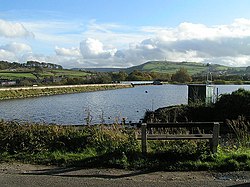
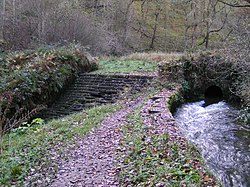
Kettleshulme (Old Norse Ketil's island or Ketil's watermeadow) is a village and former civil parish, now in the parish of Kettleshulme and Lyme Handley, in the Cheshire East district, in the ceremonial county of Cheshire, England. The village is close to the border with Derbyshire, on the B5470 road from Whaley Bridge to Macclesfield in the valley of the Todd Brook, a tributary of the River Goyt. In 2001 the parish had a population of 353.

1. Geology and climate

The geology around Kettleshulme consists of Carboniferous limestone, shale and gritstone. The original settlement mainly consisted of a mixture of limestone and sandstone buildings, including the old church, built in the 19th century out of limestone quarried near Buxton, seven miles away. The village is 1,000 feet (300 m) above sea level; the nearest weather station in Buxton recorded that the area has a mean annual temperature of 7.8 °C and average annual rainfall of 1,286 millimetres (50.6 in).

1. Transport and accessibility

The village is in the Pennines, 13 miles (21 km) from the centre of Manchester, making it popular with commuters. A bus service from Disley goes through Kettleshulme to Macclesfield. The nearest railway station is Whaley Bridge on the Manchester–Buxton line.

1. Economy and tourism

Kettleshulme was once a centre for the manufacture of candle-wick material but this ceased in 1937. The old abandoned mill (Lumbhole Mill 1797, rebuilt 1823) still exists but is not in use. It is a Grade II* listed building, described by English Heritage as "the last example of a mill where water-powered and steam machinery were used together and survive intact". Kettleshulme was the home of 19th-century record-breaker Amos Broadhurst, whose beard grew to a length of seven feet. The area around Kettleshulme is popular with walkers. To the north are the Bowstones, an early Christian stone sculpture, and nearby Lyme Park. From the Bowstones, it is possible on a clear day to see up to thirty miles in all directions, including, to the west, the Lovell Telescope at Jodrell Bank, at one time the world's largest radio telescope, to the north-west, the city of Manchester and its airport and to the east, the rest of the High Peak including Kinder Scout, the Derbyshire's highest point, and Windgather Rocks.

1. History

Kettleshulme was formerly a township in the parish of Prestbury, from 1866 Kettleshulme was a civil parish in its own right, on 1 April 2023 the parish was abolished and merged with Lyme Handley to form "Kettleshulme and Lyme Handley".

1. See also

Listed buildings in Kettleshulme

1. References


1. External links

Kettleshulme Parish website

Nearby Places View Menu
Location Image
1.5 km

Windgather Rocks

The Windgather Rocks (416 metres/1,365 ft a.s.l.) is a gritstone crag on the Derbyshire–Cheshire border in England. It is in the Peak District National Park and is a popular site for learning the rudiments of rock climbing. As the name suggests the area is exposed to the prevailing westerly winds. The rocks lie above Taxal Edge and are part of a north–south ridge that starts between Kettleshulme and Whaley Bridge and culminates at Shining Tor. The crag was featured in the first guide to rock climbing in the Peak District, Some Gritstone Climbs, published in 1913 and written by John Laycock.
Location Image
2.0 km

Toddbrook Reservoir

Toddbrook Reservoir, a feeder for the Peak Forest Canal, opened in 1838. It is above the town of Whaley Bridge in the High Peak area of Derbyshire, England. The reservoir is a Site of Special Scientific Interest (SSSI) providing habitats for herons, ducks and other animals and fish, while rare mosses and liverworts grow on its shores, particularly short-lived species that grow on seasonally exposed mud. The reservoir is used for sailing and angling. The Peak District Boundary Walk runs around the eastern end of the reservoir. The reservoir is owned by the Canal & River Trust and, like the nearby Combs Reservoir, is a feeder reservoir for the Peak Forest Canal. The feeder runs through Whaley Bridge, and with the Combs feed enters the canal system in a pool close to the transhipment shed at the Whaley Bridge canal basin. The reservoir is fed from the Todd Brook, a stream which has a catchment area of around 1,700 hectares (4,200 acres) including the moorland on Shining Tor and farmland around Kettleshulme village. Water enters the reservoir on its north bank via a small waterfall. The first several inches of water do not flow into the reservoir but flow down the reservoir's run-off into the River Goyt. The reservoir often receives little or no inflow during periods when rainfall does not allow the level to exceed the barrier, and this often affects the reservoir's water level, particularly in the summer months. The reservoir's dam is built from earth with a puddle clay core. The embankment is straight in plan and approximately 310 m (1,020 ft) long. The average crest level is 187.3 metres (615 ft) AOD. In August 2019, concrete panels on its spillway were dislodged after heavy rain, triggering the evacuation of parts of Whaley Bridge and the surrounding area due to the possibility of the dam collapsing.
Location Image
2.2 km

Bowstones

The Bowstones or Bow Stones are a pair of Anglian cross shafts in Cheshire, England. Situated beside the old ridgeway between Disley and Macclesfield, overlooking Lyme Park, the Cheshire Plain, the city of Manchester and the hills of the Peak District, they are a scheduled monument. The western shaft is 1.22 metres (4 ft 0 in) high and tapers from circumference of 1.25 m (4 ft 1 in) at the base to 0.86 m (2 ft 10 in) at the top. The eastern shaft is 0.98 m (3 ft 3 in) high and has a circumference of 1.27 m (4 ft 2 in). Both are decorated with interlaced carvings in a style indicating a date of the 10th century or earlier. There is some later lettering engraved. Their round cross section and their erection as a pair is unusual for crosses of this era. They may have been moved to their current location in the 16th century by Sir Piers Legh of Lyme Hall. Two stone cross heads on display at the hall may have originally surmounted the shafts. Local legend states that the name is derived from their use by Robin Hood and his men to re-string their bows. Their location on a prominent ridgeline on the edge of the Peak District National Park with extensive views, near to the popular visitor attraction of Lyme Park and by the crossing of several public footpaths (including the Gritstone Trail) and a minor road make them a well-visited site.
Location Image
2.4 km

Todd Brook

Todd Brook is a small river running through the English counties of Cheshire and Derbyshire. The Brook rises beneath Shining Tor on the border between the two counties and flows northwards through east Cheshire, passing by Jenkin Chapel, Windgather Rocks and Kettleshulme before turning east, forming the border between Cheshire and Derbyshire for a short distance before filling Toddbrook Reservoir in Derbyshire. The brook flows into the River Goyt at Whaley Bridge. The brook's Environment Agency pollution classification changed from good to moderate in 2014.