

 English
 Français

Barden (Craven)
Barden est une paroisse civile du Yorkshire du Nord, en Angleterre.
Nearby Places View Menu
10 m
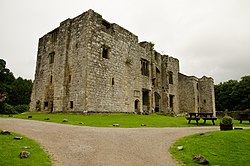
Barden Tower
Barden Tower is a ruined building in the Parish of Barden, in Wharfedale, North Yorkshire, England. The tower was used as a hunting lodge in the 15th and 16th centuries, and despite a renovation in the 1650s, it fell into disrepair in the 18th century. The tower is now part of the Bolton Estate and is listed as a medieval fortified tower. Along with other buildings on the Bolton Estate, it is a focal point and many people visit the tower. It is also a way marker on the 100-mile (160 km) Lady Anne's Way long distance path.
39 m
Barden Old Chapel
Barden Old Chapel, also known as Barden Tower Chapel or Barden Church, is a historic building in Barden near Skipton in North Yorkshire, in England.
The chapel was constructed in the 16th century, to serve neighbouring Barden Tower. The interior was restored in the 19th century, but later gutted. Despite this the building was occasionally used for worship until the 1950s, but thereafter was boarded up and used only for storage. In 1954, it was grade I listed, but it was later placed on the Heritage at Risk Register. In 2015, the Bolton Abbey Estate restored the building as an events venue.
The single-storey building is constructed of stone and has a stone slate roof. It is two bays long, and is supported by an angle buttress. To the left of the buttress is the doorway, and to its left is a six-light mullioned window. There is a further three-light window in the left wall. Inside, the original font survives, along with metalwork from the 2015 renovation. There is also a kitchen, with cellar below.

44 m
Priest's House, Barden
The Priest's House, formerly known as Barden Tower Farmhouse, is a historic building in Barden, Craven, a village near Skipton in North Yorkshire, in England.
The building was constructed in 1513, as a hunting lodge associated with neighbouring Barden Tower. It later served as a house for a worker at the tower, then as a farmhouse, before becoming a restaurant. It was Grade I listed in 1954.
The building is constructed of stone, with a stone slate roof. It is three bays wide, partly two storeys high, but the right-hand bay is a three-storey tower. The tower has a parapet, a crocketed pinnacle on the corners, and a large stepped buttress. The left two bays have parapeted gables. The windows have chamfered surrounds, and either a single light, or are mullioned with elliptical-headed lights. The doorway has a chamfered surround and an elliptical head.

240 m
Barden, Craven
Barden is a civil parish in the county of North Yorkshire, England. It consists of the hamlet of Drebley and a few scattered houses in Wharfedale in the Yorkshire Dales. The parish also includes two areas of moorland, Barden Fell to the east of the River Wharfe and Barden Moor to the west of the river. Both moorlands are access land, and are popular with walkers. Barden Fell rises to the prominent peak of Simon's Seat, and Barden Moor includes two scenic 19th century reservoirs. Much of the parish is on the Bolton Abbey estate.
The parish is sparsely populated. At the 2011 Census the population of the civil parish was less than 100, and the census statistics for the parish were therefore merged with those of the adjoining civil parish of Hazlewood with Storiths. In 2015, North Yorkshire County Council estimated that the population of the parish was 90.
Until 1974 it was part of the West Riding of Yorkshire. From 1974 to 2023 it was part of the district of Craven, it is now administered by the unitary North Yorkshire Council.
Barden is derived from the Old English berdene, and means the valley where the barley is grown.

2.9 km
High Hall
High Hall is a historic building in Appletreewick, a village in North Yorkshire in England.
The house was built in 1535, by the father of William Craven, a Lord Mayor of London. The building was altered in the 17th century. The house was Grade II* listed in 1954. It was extensively restored in the early 21st century, and was then made available as a holiday let. In 2023, it was placed on the market, for £2.5 million.
The stone house has three storeys and a basement. It is two bays wide, and has a central porch. On the ground floor is the great hall, which has an eight-light mullioned and transomed window, with some 17th century diamond pane glazing. There are similar, smaller windows around the rest of the house, with the five illuminating the staircase being stepped. There is a further porch on the right-hand side. Inside, the great hall has an inglenook fireplace and diamond-shaped stone paving. Above it is a drawing room with a frieze dating from about 1600. Many of the original fittings survive, including the dogleg staircase.