Le Bowling Green est un petit jardin public du quartier de Lower Manhattan à New York, situé au pied de Broadway, près du site du quartier hollandais de La Nouvelle-Amsterdam. Construit en 1733, son nom vient du fait qu'il comportait à l'origine un boulingrin (bowling green). En forme de goutte d'eau, il est le parc public le plus ancien de New York, et il est encore à ce jour entouré par une barrière datant du XVIIIe siècle. Au nord du jardin se trouve la sculpture du taureau de Wall Street (Charging Bull). Le Bowling Green Fence and Park fait partie du Registre national des lieux historiques.

1. Description


1. Historique


1. Monuments voisins

(dans le sens des aiguilles d'une montre)

Alexander Hamilton US Custom House au Sud 1 Broadway, the United States Lines-Panama Pacific Line Building Bowling Green Building, 11 Broadway (1895–98, W. and G. Audsley, puis siège de White Star Line) Cunard Building, 25 Broadway (1921, Benjamin Wistar Morris et Carrère and Hastings (en)) 26 Broadway, Standard Oil Company Building (1922, Carrère and Hastings et Shreve, Lamb and Blake) 2 Broadway (1959–60, Emery Roth & Sons, 1999 Skidmore, Owings and Merrill) La sculpture du Taureau de Wall Street jouxte le parc depuis 1989. La statue Fearless Girl lui a fait face de 2017 à 2018.

1. Notes et références


1. Annexes


1. = Liens externes =

Ressource relative à l'architecture : Registre national des lieux historiques

Portail du Registre national des lieux historiques Portail de New York Portail des espaces verts

Nearby Places View Menu
Location Image
0 m

Bowling Green (New York City)

Bowling Green is a small historic public park in the Financial District of Lower Manhattan in New York City, at the southern end of Broadway. Built in the 18th century next to the site of the original Dutch fort of New Amsterdam, it served as a public gathering place and under the British was designated as a park in 1733. It is the oldest public park in New York City and is surrounded by its original 18th-century cast iron fence. The park included an actual bowling green and a monumental equestrian statue of King George III prior to the American Revolutionary War. Pulled down in 1776, the 4000-pound statue is said to have been melted for ammunition to fight the British. Bowling Green is adjacent to another historic park, the Battery, located to the southwest. It is surrounded by several buildings, including the Alexander Hamilton U.S. Custom House (with the NYC office of the National Archives), the International Mercantile Marine Company Building, Bowling Green Offices Building, Cunard Building, 26 Broadway, and 2 Broadway. The Charging Bull sculpture is located on the northern end of the park. The park is listed on the U.S. National Register of Historic Places under the name Bowling Green Fence and Park. It is also a contributing property to the Wall Street Historic District, an NRHP district created in 2007.
Location Image
33 m

Williams-Whittlesey Co.

Williams-Whittlesey Motor Boat and Shipbuilding Co., often referred to as Williams-Whittlesey Co. and known until 1904 as the Standard Boat Co., was an American boatbuilding company in Queens, New York, that operated at least from 1891 to 1910. Headquartered in Long Island City with a boatyard in the adjacent Astoria neighborhood, the company produced tugboats, river vessels, scows, and yachts. Among its products were two private motorboats that were later commissioned by the United States Navy for service during World War I: Osprey II, which served as USS Osprey II (SP-928) from 1917 to 1918; and Althea, which served as USS Althea (SP-218) from 1917 to 1919. In 1904, the Standard Boat Co.'s owners changed the name to Williams-Whittlesey Motor Boat and Shipbuilding Co. because they "felt that their firm was very often confused with the Standard Motor Construction Co. of Jersey City, New Jersey". Among its naval architects was H. Newton Whittelsey, whose yacht designs were noted for introducing "the modern type of large raised deck cruiser," according to Motor Boating magazine. Another employee was Daniel I. Whittlesey, a 1901 graduate of Yale University's Sheffield Scientific School. By 1916, Whittelsey and Whittlesey had formed their own shipbuilding company headquartered at 11 Broadway in Manhattan.
Location Image
37 m

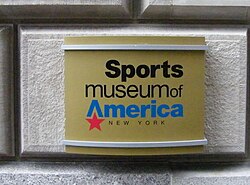
Sports Museum of America

The Sports Museum of America (SmA) was the United States' first national sports museum dedicated to the history and cultural significance of sports in America. It opened in May 2008 and closed less than nine months later, in February 2009. The Sports Museum of America was the nation's first major museum incorporating most major sports. In addition to becoming the official home of the Heisman Trophy and its annual presentation, the museum also housed the first-ever Women's Sports Hall of Fame. Among its board of directors were Mario Andretti, Martina Navratilova, Joe Frazier, Bob Cousy, Billie Jean King, Paul Hornung, and fifty other Hall of Fame athletes. The museum was located in Lower Manhattan at the end of the Canyon of Heroes, at 26 Broadway, across from Bowling Green, close to the Statue of Liberty and Ellis Island ferry, the Whitehall Terminal of the Staten Island Ferry, Wall Street, and the World Trade Center.
Location Image
56 m

New York Produce Exchange

The New York Produce Exchange was a commodities exchange headquartered in the Financial District of Lower Manhattan in New York City. It served a network of produce and commodities dealers across the United States. Founded in 1861 as the New York Commercial Association, it was originally headquartered at Whitehall Street in a building owned by the New York Produce Exchange Company. The Association was renamed the New York Produce Exchange in 1868 and took over the original building in 1872. Between 1881 and 1884, the Produce Exchange built a new headquarters on 2 Broadway, facing Bowling Green in Lower Manhattan. The structure, designed by George B. Post, was the first in the world to combine wrought iron and masonry in its structural construction. The main feature of the structure was an exchange floor that measured approximately 220 by 144 feet (67 by 44 m). The Produce Exchange was profitable following the building's completion. By the 1880s, it had the largest membership of any exchange in the United States, with a maximum of three thousand members. By 1900, the exchange was doing $15 million a day in business. In the early 20th century, activity on the Produce Exchange started to decline due to competition from other cities. The Produce Exchange sold off its building for development in the 1950s; the headquarters was demolished to make way for a skyscraper called 2 Broadway. The exchange had its trading floor in the skyscraper from 1959 until 1973, when it was restructured as the Produce Exchange Realty Trust, a real estate investment trust.
Location Image
56 m

Bowling Green Offices Building

The Bowling Green Offices Building (also known as the Bowling Green Building, Bowling Green Offices, or 11 Broadway) is an office building located at 11 Broadway, across from Bowling Green park in the Financial District of Manhattan in New York City. The 21-story building, erected between 1895 and 1898, is 272.5 feet (83.1 m) tall. The Bowling Green Offices Building was built to a Hellenic Renaissance-style design by W. & G. Audsley. The building's articulation consists of three horizontal sections similar to the components of a column—namely a base, shaft, and capital—and has a facade of granite at its base and white brick on the upper stories. The building contains an interior skeleton of structural steel, several ornamental features on the facade, as well as a floor plan that maximizes natural light exposure. The Bowling Green Offices Building, erected as a 16-story structure, initially hosted various steamship offices due to Bowling Green's proximity to the New York Harbor, and later hosted law firms and other companies. The Broadway Realty Company, for whom the building was built, owned 11 Broadway for several decades following its completion. Five additional stories were built in 1920–1921. In 1995, the New York City Landmarks Preservation Commission (LPC) designated 11 Broadway as an official city landmark. It is also a contributing property to the Wall Street Historic District, a National Register of Historic Places district created in 2007.