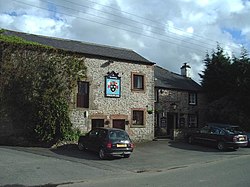
Thrimby is a hamlet and former civil parish, now in the parish of Little Strickland, in Westmorland and Furness, Cumbria, England. In 2001 the population of the civil parish of Thrimby was 30. The population measured at the 2011 Census was less than 100. Details are included in the parish of Great Strickland. It has a Grade 2* farmhouse called Thrimby Hall, as seen in series 4 of the BBC Two fly-on-the-wall farming documentary "This Farming Life".

1. History

Thrimby was a chapelry with 2 townships within Morland parish. It became a civil parish in 1866. On 1 April 2019 the parish was merged with Little Strickland. On 23 October 1970, the nine-mile Tebay to Thrimby section of the M6 was opened, built by Christiani-Shand. The section terminated on the A6. The next junction further north would be at Penrith (A66).

1. See also

Listed buildings in Thrimby List of English and Welsh endowed schools (19th century)

1. References


1. External links

"Cumbria County History Trust: Thrimby". (nb: provisional research only – see Talk page) "Thrimby". GENUKI. Retrieved 3 August 2023. "Listed Buildings in Thrimby, Eden, Cumbria". British Listed Buildings. Retrieved 3 August 2023. Wainwright, A. (2004). Westmorland Heritage. Frances Lincoln Limited. ISBN 9780711224193. "Little Strickland (Thrimby) – St Mary's Church". Visit Cumbria. Retrieved 3 August 2023. "St Mary's Church, Thrimby, in Little Strickland". Archived from the original on 29 March 2016. "St Mary, Little Strickland". A Church Near You. Retrieved 3 August 2023.

Nearby Places View Menu
Location Image
1.4 km

Little Strickland

Little Strickland is a small village and civil parish in the Westmorland and Furness district of Cumbria, England. It is about 7 miles (11 km) from Penrith and 8 miles (13 km) from the small town of Appleby-in-Westmorland. The village has one place of worship and a telephone box. The population of the civil parish as taken at the 2011 Census was less than 100. Details are included in the parish of Great Strickland. On 1 April 2019 Thrimby parish was merged with Little Strickland.
Location Image
2.4 km

Great Strickland

Great Strickland is a village and civil parish in the Eden Valley between the Cumbrian mountains in the west and the Pennines in the east. It is 5 miles (8.0 km) south east of Penrith, and is in the former county of Westmorland. At the 2011 Census Great Strickland was grouped with Little Strickland, itself enlarged to include Thrimby after 2001, to give a total population of 370. The equivalent figure from the 2001 census was 342. The sandstone village church is dedicated to Saint Barnabas and was constructed in 1872. It has a bell turret. To the west of the village lies the River Leith, the West Coast Main Line and the M6 Motorway. To the south lies the small settlement of Little Strickland.
2.5 km

Leath

Leath was one of the wards of the historic county of Cumberland in north west England. Unlike most other English counties, Cumberland was divided into wards rather than hundreds. The ward was bounded on the south by Westmorland, the north by Cumberland and Eskdale wards, the east by the counties of Northumberland and Durham and on the west by the wards of Allerdale above Derwent and Allerdale below Derwent. In the Imperial Gazetteer of England and Wales (1870–72) John Marius Wilson described Leath: LEATH, a ward in Cumberland; bounded by Northumberland, Durham, and Westmoreland, and by the wards of Eskdale and Allerdale; and containing Addingham parish, twenty other parishes, and part of another. Acres, 216,296. Pop. in 1851, 29,103; in 1861, 28,675. Houses, 5,819. The ward largely corresponds to that part of the modern Eden District that lies within Cumberland that is the former Penrith urban and rural districts and the Alston with Garrigill Rural District. Market towns in the ward were Penrith (the largest settlement and seat of local government), Kirkoswald and Alston. At one time, the village of Greystoke had held markets. A large part of the ward once made up the main part of the Royal hunting ground known as Inglewood Forest, which was subject to Forest Laws up until the reign of Henry VIII. The manors of Penrith, Langwathby, Castle Sowerby and Great Salkeld and at times Glassonby and Gamblesby were part of the royal estate known as the Honour of Penrith, which eventually passed into the hands of the Dukes of Devonshire.
Location Image
2.7 km

Hackthorpe

Hackthorpe is a hamlet in Westmorland and Furness, in the county of Cumbria, England. Circa 1870, it had a population of 110 as recorded in the Imperial Gazetteer of England and Wales.