

 English
 Français

High Street (Lake District)
High Street is a fell in the English Lake District. At 828 metres (2,717 ft), its summit is the highest point in the far eastern part of the national park. The fell is named after the Roman road that ran over the summit.
Nearby Places View Menu
862 m
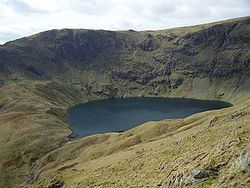
Blea Water
Blea Water is a tarn or corrie lake which occupies a glacially excavated hollow immediately to the east of High Street in the Lake District, England. At just over 200 feet (61 m) deep, it is the deepest tarn in the Lake District.
It is drained by the Mardale Beck, which runs north-east into Haweswater.

1.1 km
Mardale Ill Bell
Mardale Ill Bell is a fell in the English Lake District, rising to the south west of Haweswater Reservoir. It stands on the watershed between Mardale and Kentmere and is the highpoint of the south-eastern ridge of High Street, midway on its course to Harter Fell.

1.3 km
Thornthwaite Crag
Thornthwaite Crag is a fell in the English Lake District, standing to the west of Haweswater Reservoir. It is a focal point of the Far Eastern Fells, standing at the head of several valleys.
1.4 km
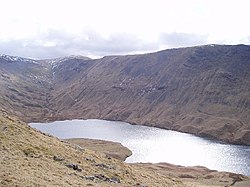
Hayeswater
Hayeswater is a small lake within the Lake District of Cumbria, England.
The lake is situated about a mile (1.6 km) SE of the hamlet of Hartsop in the Patterdale Valley. It nestles between The Knott to its east and Gray Crag to the west and it is at an altitude of almost 1,400 feet (425 m). The lake is natural but was dammed in 1908 to provide a reservoir serving the Cumbrian town of Penrith. It is fed from the south by Hayeswater Gill, which rises close to the route of the Roman High Street and continues to Cow Bridge where it joins the outlet stream from Brothers Water.
It had not been used as a reservoir since 2005 and United Utilities removed the dam and restored it to a mountain tarn in the summer of 2014. A new footbridge over Hayeswater Beck was also constructed 250 yards downstream from the tarn outlet channel.
Hayeswater Tarn is also a popular yet remote destination for adventurous anglers and fly fishermen and women, with the tarn holding a good number of native wild brown trout. Tadpoles, caddis and olives are prolific and make up a big part of the trout`s diet. On occasion osprey can be seen over the tarn.