

 English
 Français

The Black Merchant Seamen War Memorial is a sandstone stone memorial, It is situated in Falkner Square, Liverpool. The stone is from the Liverpool Seamen's Hostel with a bronze plaque dedicated to all the Black Seamen who served during World War II. It was unveiled in 1993 on the 50th anniversary of the Battle of the Atlantic.
Nearby Places View Menu

0 m
Falkner Square
Falkner Square is a square in Canning on the border of Liverpool city centre and Toxteth. Falkner Square Gardens occupy the centre of the square. The Square was completed in 1830 and in 1835 the central area was acquired as a park, one of the first areas so acquired by the council.
130 m
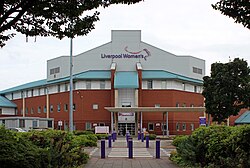
Liverpool Women's Hospital
Liverpool Women's Hospital is a major obstetrics, gynaecology and neonatology research hospital in Liverpool, England.
It is one of several specialist hospitals located within the Liverpool City Region, alongside Alder Hey Children's Hospital, Liverpool Heart and Chest Hospital, the Walton Centre, Mersey Regional Burns and Plastic Surgery Unit and Clatterbridge Cancer Centre.
It became part of NHS University Hospitals of Liverpool Group on 1 November 2024.
The hospital receives approximately 50,000 patients annually and is the largest hospital for its specialism in Europe.

134 m
Falkner Street
Falkner Street is a street mostly in Canning, with a short section in Edge Hill, Liverpool, England. The street, built during the early-mid 19th century, is named after Edward Falkner, who had previously commissioned the construction Falkner Square. Constructed at a time when Liverpool had less than 100,000 houses, the Falkner Street houses sold for around £1,000 (equivalent to £123146 in 2023) and were affordable to only the wealthiest 1% of the population.

242 m
Liverpool Women's Hospital bombing
On 14 November 2021, a taxi carrying a passenger arrived at the main entrance of Liverpool Women's Hospital in Liverpool, England. An improvised explosive device (IED) carried by the passenger ignited, killing him and injuring the driver. The police later declared it to be a terrorist incident; the perpetrator had been refused asylum in 2014, lost appeals in 2015, and lived in England until his attack.
At the official inquest, on 30 December 2021, it was found that the device, manufactured and carried by the passenger, had been "designed to project shrapnel, with murderous intent".