

 English
 Français
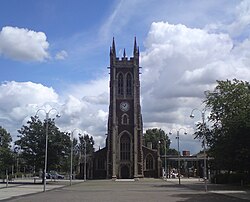
Scunthorpe
Scunthorpe est une ville anglaise du North Lincolnshire. Sa population est estimée à 72 514 habitants. C'est une ville industrielle avec une grande aciérie.
Nearby Places View Menu

2.8 km
Scunthorpe Steelworks
Scunthorpe Steelworks is a steel mill with blast furnaces in North Lincolnshire, England. As of April 2025, the facility employs around 2,700 people. It is the last plant in the UK capable of producing virgin steel, which is used in major construction projects like new buildings and railways. The rest of the UK's steel industry produces recycled steel using electric arc furnaces.
The iron and steel industry in Scunthorpe was established in the mid-19th century, following the discovery and exploitation of middle Lias ironstone, east of Scunthorpe (Lincolnshire).
Initially, iron ore was exported to iron producers in South Yorkshire. Later, after the construction of the Trent, Ancholme and Grimsby Railway (1860s) gave rail access to the area, local iron production rapidly expanded, using local ironstone and imported coal or coke. The local ore was relatively poor in iron (around 25% average) and high in lime (CaCO3) requiring co-smelting with more acidic silicious iron ores. The growth of industry in the area led to the development of the town of Scunthorpe in a formerly sparsely populated, entirely agricultural area.
From the early 1910s to the 1930s, the industry consolidated, with three main ownership concerns formed—the Appleby-Frodingham Steel Company, part of the United Steel Companies; the Redbourn Iron Works, part of Richard Thomas and Company of South Wales (later Richard Thomas and Baldwins); and John Lysaght's Normanby Park works, part of Guest, Keen and Nettlefolds.
In 1967, all three works became part of the nationalised British Steel Corporation (BSC), leading to a period of further consolidation—from the 1970s the use of local or regional ironstone diminished, being replaced by imported ore via the Immingham Bulk Terminal—much of the steelworks was re-established with equipment at or south and east of the Appleby-Frodingham works during the late 1960s as part of the Anchor modernisation. Primary iron production was at four blast furnaces first established or expanded in the 1950s, and known as the four Queens: named Queen Anne, Bess, Victoria and Mary.
Both the Normanby Park and the Redbourn works were closed by the early 1980s. Conversion to the Linz-Donawitz process (LD) of steel making from the open hearth process took place from the late 1960s onwards, with an intermediate oxygen utilising open hearth process known as the AJAX furnace operated in the interim. Conversion to LD operation was complete by the 1990s.
Following privatisation in 1988, the company, together with the rest of BSC, became part of Corus (1999), later Tata Steel Europe (2007). In 2016, the long products division of Tata Steel Europe was sold to Greybull Capital with Scunthorpe as the primary steel production site, under the historic British Steel name. Jingye Group purchased British Steel in 2020.
Following the closure of the last blast furnace at Port Talbot Steelworks in Wales in September 2024, Scunthorpe Steelworks is the UK's only remaining primary steelmaking facility.

4.0 km
Eddie Wright Raceway
The Eddie Wright Raceway is a British race track in Scunthorpe, North Lincolnshire. It is primarily used for motorcycle speedway, but also occasionally hosts stock car racing.
4.0 km
Normanby Park railway station
Normanby Park railway station was a goods station, built by the North Lindsey Light Railway, in Normanby, Lincolnshire, England. Situated some 1 7/8 miles from Scunthorpe it opened on 1 August 1912, the increase in traffic on the line being due to the commissioning of new blast furnaces at the nearby works of John Lysaght & Company.
4.6 km
Gokewell Priory
Gokewell Priory was a Cistercian Catholic priory in Broughton, Lincolnshire, England.
The priory was founded by William de Alta Ripa, and received financial support from Roger of St. Martin, Adam Paynel, and William de Romara. By 1440, the priory housed eight nuns; it was probably never much larger. On a visit, Bishop William Alnwick found the priory to be very poor, but in good order.
In early 1536, Gokewell Priory was permanently closed as part of the Dissolution of the Monasteries ordered by King Henry VIII.

5.3 km
Flixborough
Flixborough is a village and civil parish in North Lincolnshire, England. The population at the 2011 census was 1,664. It is near the River Trent, 3 miles (5 km) north-west from Scunthorpe. The village is noted for the 1974 Flixborough disaster.
Flixborough is in the Burton upon Stather and Winterton ward of North Lincolnshire Council, and its boundary covers the southern part of Normanby Park. Its Grade II listed Anglican church is dedicated to All Saints. The village public house is The Flixborough Inn on High Street.