

 English
 Français
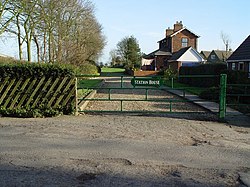
Keyingham railway station is a disused railway station on the North Eastern Railway's Hull and Holderness Railway to the north of Keyingham, East Riding of Yorkshire, England. It was opened by the Hull and Holderness Railway on 27 June 1854. The station was closed to passengers on 19 October 1964.
Nearby Places View Menu

520 m
Keyingham
Keyingham is a village and civil parish in the East Riding of Yorkshire, England. The village is situated approximately 10 miles (16 km) east of Kingston upon Hull city centre and lies on the A1033 road.

1.9 km
A1033 road
The A1033 road is a main arterial route across Kingston upon Hull and the East Riding of Yorkshire connecting Hull with Withernsea. The road carries traffic to and from the Port of Hull and Salt End at its western end, and local and holiday traffic at its eastern end. It is a primary route from the junction of the A63 road to the Salt End roundabout and is maintained on that section by National Highways. The section by the docks is also part of a designated abnormal load route.
The section northwards from the A63 junction to Dunswell, is known to have traffic problems.

2.2 km
Ottringham railway station
Ottringham railway station is a disused railway station on the North Eastern Railway's Hull and Holderness Railway to the north of Ottringham, East Riding of Yorkshire, England.

2.4 km
Ottringham
Ottringham is a village and civil parish in the East Riding of Yorkshire, England, in an area known as Holderness. It is situated approximately 12 miles (19 km) to the east of Hull city centre and 5 miles (8 km) south-west of Withernsea. It lies on the A1033 road from Hull to Withernsea.
According to the 2011 UK census, Ottringham parish had a population of 597, a reduction on the 2001 UK census figure of 637.
In 1823 parish inhabitants numbered 637. Occupations included twelve farmers, some of whom were land owners, four shoemakers, three grocers, two tailors, two wheelwrights, a blacksmith, a corn miller, a horse dealer, and the landlord of the White Horse public house. Two carriers operated between the village and Hull, South Frodingham, Holmpton, and Skeckling, on Tuesdays and Fridays. Letters were received and sent on Mondays, Wednesdays and Saturdays by Wing's caravan [accommodation coach]. A Methodist chapel existed, built in 1815.
The name Ottringham possibly derives from the Old English Oteringashām or Oteringhām, meaning 'village of Oter's people' or 'village at the otter place'.
The parish church of St Wilfrid is a Grade I listed building. In November 2024 the church was placed on the Heritage at Risk Register by Historic England who gave a grant to start repairs.
Ottringham was served from 1854 to 1964 by Ottringham railway station on the Hull and Holderness Railway.
During the Second World War, in 1943, the BBC built a transmitting station at Ottringham, called BBC Ottringham or OSE5. Its purpose was to counter the increase in German jamming signals, and to broadcast propaganda into Germany. Following the end of the war, and with lack of funds, the station was deconstructed in 1953 and its transmitters moved to Droitwich.
In 1958 a Ham class minesweeper HMS Ottringham was named after the village.
Ottringham contains two public houses and a service garage. It is close to a main bus route.