

 English
 Français

Firrhill
Firrhill is a suburb of Edinburgh, the capital of Scotland. It is south of Merchants of Edinburgh Golf Club and lies next to Oxgangs. The area is mostly made up of public housing which was built by the Corporation Housing Department in the mid-1950s, however most of the council properties have now been bought by tenants using the right to buy scheme although a fairly large number of these are rented out privately by individual landlords. Firrhill High School lies in the area.
1. Sources
(Google Maps)
Nearby Places View Menu
308 m
Firrhill High School
Firrhill High School is a secondary school located in the south-west of Edinburgh, Scotland. The school was established in 1960, and was officially opened by the city's lord provost. The school has around 1123 pupils and a teaching staff roll of around 121. The school serves areas such as: Oxgangs, Colinton Mains, Colinton Village, Bonaly, Fairmilehead, Buckstone, Craiglockhart and Longstone.
In 2001, the school underwent drastic refurbishing work, with several run-down buildings dating from the 1960s being either refurbished or demolished with new buildings built in their place. Work was completed in mid-2005, and the school was refurbished by a private finance initiative.
369 m
Edinburgh City Hospital
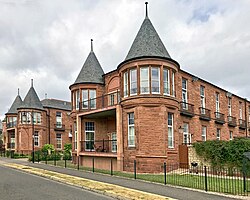
The Edinburgh City Hospital (also known as the Edinburgh City Hospital for Infectious Diseases or the City Hospital at Colinton Mains) was a hospital in Colinton, Edinburgh, opened in 1903 for the treatment of infectious diseases. As the pattern of infectious disease changed, the need for in-patients facilities to treat them diminished. While still remaining the regional centre for infectious disease, in the latter half of the 20th century the hospital facilities diversified with specialist units established for respiratory disease, ear, nose and throat surgery, maxillo-facial surgery, care of the elderly and latterly HIV/AIDS. The hospital closed in 1999 and was redeveloped as residential housing, known as Greenbank Village.
607 m
Oxgangs high rise flats
The Oxgangs tower blocks (known locally as the Oxgangs high rise flats) were a group of 3 tower blocks which were built on Firrhill Drive/Oxgangs Crescent in 1961 and 1962. They each contained a mixture of flats and maisonettes with 2 bedrooms each, totalling up to 80 homes per block. The blocks were called "Allermuir Court" "Caerketton Court" and "Capelaw Court", and were named after three of the nearby Pentland Hills.
The original name of the group of three blocks was "Comiston Luxury Flats". They boasted outstanding views across Edinburgh, and offered a much better place to live than the slums of the inner city. However, a short while after their completion several problems were drawn into attention such as dampness, and after the 1970s the original families were beginning to move out of the blocks in search of other housing.
In 2003, Social Justice Minister Margaret Curran announced £10,000,000 in funding for demolition of the blocks and rebuilding of affordable housing on the site. Work began in 2003 with the decanting of Capelaw Court and by 2004 it was empty, finally being demolished (with the use of controlled explosives) on 17 April 2005. The demolition was screened live worldwide by the National Geographic Channel. Allermuir and Caerketton Court were next and they were both demolished within seconds of each other on 26 November 2006. On the site of Capelaw Court, 60 flats and 31 houses were built (managed by Dunedin Canmore Housing Association, Communities Scotland and the city council, in partnership). The first residents moved back to the new homes in early 2007. The site of the other two tower blocks is currently being developed into more housing. The whole project was due to be completed in around 2009/10.

656 m
Dovecot Studios
Dovecot Studios or Dovecot is a tapestry studio and arts venue in Edinburgh, Scotland.
Dovecot Studios was established by the 4th Marquess of Bute in 1912, recruiting weavers from William Morris' workshops at Merton Abbey in London. The Marquess commissioned the studios to produce large tapestries for Mount Stuart House, his home on the Isle of Bute. Dovecot Studios' first home was in Corstorphine, which at the time was a village on the west side of Edinburgh. It was originally housed in a purpose built studio next to a sixteenth-century dovecot, the only remaining part of the medieval Corstorphine Castle.
After the Second World War, the studios became known as Edinburgh Tapestry Company. They focused on working with the most famous contemporary British artists, with individuals including Henry Moore and Graham Sutherland providing designs for tapestries. In 2001 it lost its financial support and went into liquidation. However the company was purchased and renewed by a new board of directors the same year, but could not remain at the Corstorphine site.
Since 2008 Dovecot Studios has been residing in the refurbished Infirmary Street Baths in central Edinburgh, which gives a new life and purpose to what was a derelict building.
As well as housing the Studio's Tapestry Studio, Dovecot's Infirmary Street home now also includes a cafe, shop, event hire spaces and three exhibition galleries. These spaces have shown a number Dovecot-curated and touring exhibitions, including "Weaving The Century: Tapestry from Dovecot Studios 1912–2012", "Jerwood Makers Open" and exhibitions by artists as diverse as Ptolemy Mann, Wendy Ramshaw and Michael Brennand Wood.
During the 2012 Edinburgh Fringe, musical performance "A Tapestry Of Many Threads" written by Alexander McCall Smith and Tom Cunningham received its world premiere on the weaving floor at Dovecot to critical acclaim. The performance celebrated a decade of Dovecot weaving and included performers from the Royal Conservatoire of Scotland. "A Tapestry Of Many Threads" won a 2012 Herald Angel Award.