

 English
 Français

Poolstock
Poolstock is a road, the name of which is used to describe the surrounding residential area of Wigan, in Greater Manchester, England. Poolstock, although it has no specific boundaries, is south of the River Douglas and is situated next to the Leeds and Liverpool Canal and close to Wigan Pier and Wigan town centre which is in walking distance. Situated close to Trenchfield Mill, Poolstock was a perfect place for Millworkers to live.
Nearby Places View Menu

29 m
St James' Church, Poolstock
St James' Church is in the Poolstock district of Wigan, Greater Manchester, England. It is an active Anglican parish church in the deanery of Wigan, the archdeaconry of Wigan & West Lancashire, and the diocese of Liverpool. The church is recorded in the National Heritage List for England as a designated Grade II* listed building.

438 m
Hawkley Hall
Hawkley Hall was an Elixabethan mansion house in Pemberton, about 1.5 miles from Wigan and to the east of Goose Green. The Hawkley's, the original owners of the hall, came to England at the time of William the Conqueror. It passed to the Molyneux family in 1374, who considerably rebuilt it during the 17th century. It once held Oliver Cromwell and his officers during the civil war.
The hall was demolished in 1970 and a housing estate occupies the site today known as the "Hawkley Hall Estate".
440 m
Association of Greater Manchester Authorities
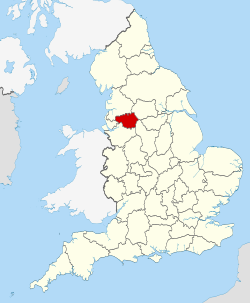
The Association of Greater Manchester Authorities (AGMA) is the local government association for Greater Manchester, a metropolitan county in North West England. Its creation followed the abolition of the Greater Manchester County Council, being established in 1986 as a governmental organisation to represent the ten district councils of Greater Manchester. AGMA was largely superseded by the Greater Manchester Combined Authority, the first authority of this new type in the United Kingdom, on 1 April 2011.
The Local Government Act 1985, which abolished the metropolitan county councils of England, included provisions for the district councils in each abolished area in England to vote to establish a county-wide replacement body if they considered this to be the most efficient and effective way of providing certain county-wide services. Greater Manchester was one of a minority of the affected urban areas in England to vote for such a new body under the Act of Parliament. AGMA has a constitution and committee structure, with the leaders of the ten district councils meeting as its head to develop county-wide policies and services.
AGMA is an organisation with "permissive statutory powers", in that seven or more of the ten district councils had to formally vote it into existence, but once established it had delegated statutory powers, staff and budgets and as such AGMA developed policy, lobbied government and others, and ran a range of services designed to make strategic and tangible advances in the standards of living across Greater Manchester.
The Executive Board of AGMA is composed of representatives from Greater Manchester's ten metropolitan boroughs, and the Greater Manchester Combined Authority, who are all members by subscription. Additionally the Bee Network Committee and the Greater Manchester Business Board, along with local authorities outside of Greater Manchester, may be admitted as non-voting associate members. Blackpool, Blackburn with Darwen, Cheshire East and Warrington have been associate members with representation at AGMA debates and meetings. AGMA also oversaw the management and policies of the Greater Manchester County Record Office, which preserved an archive with records of the local history of Greater Manchester, now known as "Archives+" and based in Manchester Central Library. The AGMA Policy and Research Unit was based in Wigan.
AGMA also chose to operate a Section 48 Grants Committee, named after the part of the Act of Parliament which permitted a levy on the district councils to fund co-ordinated grants to voluntary organisations which operated across the Greater Manchester area and who might otherwise 'slip through the cracks'. The Greater Manchester Council for Voluntary Service had been instrumental in lobbying to strengthen the powers of Section 48 of the Local Government Act 1985 when it was still being debated as a Bill in the House of Lords.
Prior to the establishment of the combined authority AGMA made representations on behalf of Greater Manchester to the government of the United Kingdom, the North West Development Agency, the European Union, business and other bodies, lobbying for investment and funding. AGMA actively pursued a formal and statutory government structure for Greater Manchester throughout the 2000s and made a successful bid to the UK's central government to constitute Greater Manchester as a Statutory City Region.

510 m
Wigan (UK Parliament constituency)
Wigan is a constituency in Greater Manchester, represented in the House of Commons of the Parliament of the United Kingdom. The seat has been represented by Lisa Nandy of the Labour Party since 2010. Nandy currently serves as Secretary of State for Culture, Media and Sport under the government of Keir Starmer.