
Villa Domínico is a city in the Avellaneda Partido. Buenos Aires Province, Argentina. It belongs to the Greater Buenos Aires urban agglomeration.

1. History

A 1580 expedition by Captain Juan de Garay, the founder of present-day Buenos Aires, resulted in land grants for an Adelantado, Torres de Vera, and a Regidor, Luis Gaitán. Melchor Maciel purchased the Gaitán heirs' land in 1619, and Maciel's widow, who remarried after his 1633 death, expanded her holdings to 24,000 hectares (60,000 acres). Following the death of their son, Luis Pesoa de Figueroa, in 1725, his widow divided the estate into four equal parcels. Juan Estanislao Zamudio purchased three of the lots, and the fourth was donated by the widow to the Roman Catholic Dominican Order, who established the Convent of Santo Domingo. The Camino Real was extended south from Sarandí by order of the Real Consulado de Buenos Aires, and the pontoon bridge built to extend the road gave this area its first informal name: Paraje del Puente Chico (Little Bridge Outpost). Andrés Pazos bought much of the land in 1820, and his rural home was counted in the 1838 census of Buenos Aires Province commissioned by Governor Juan Manuel de Rosas. Patricio Brown installed the first industrial establishment, a salted meat maker, in 1850.

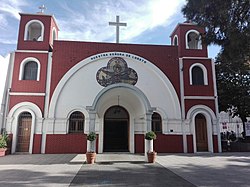
Jorge Domínico purchased the land in 1856. He sold a swath of land therein to the Buenos Aires and Ensenada Port Railway, which was completed in 1872. The first lots were sold to homesteaders on August 11, 1894. A neighboring landowner, Federico Gattemeyer, did likewise in 1908, and the Port Railway opened a station in Villa Domínico in 1909. Driven by a wave of immigration in Argentina, the settlement grew quickly, and by 1910, was home to around 1,100 inhabitants. The Villa Domínico Community Development and Mutual Aid Society was established on August 28, 1910, and by their initiative, the first fire house was opened in 1912. The Church of San José was consecrated on April 23, 1918. The cities representative in the Provincial Legislature, Fabían Onzari, succeeded in having a comprehensive flood control plan enacted for the area in 1923, and the network of canals and ancillary works, known as the Onzari Plan, was completed in 1929. The city became a bedroom community with a services-oriented economy in subsequent decades.

1. External links

Municipal information: Municipal Affairs Federal Institute (IFAM), Municipal Affairs Secretariat, Ministry of Interior, Argentina. (in Spanish)

Nearby Places View Menu
Location Image
927 m

Sarandí, Buenos Aires

Sarandí (Spanish pronunciation: [saɾanˈdi]) is a city in the Avellaneda Partido of the urban agglomeration of Greater Buenos Aires, Argentina. It is located to the south of the Autonomous City of Buenos Aires. The city has an area of 54 square kilometres (21 sq mi) and a population of 60,752 inhabitants (INDEC, 2001); the second most populated locality in the partido after Avellaneda, with 18.5% of the partido's population. The main economical activity in the area is the production of leather goods. The leather industry, especially the tanning process, is often criticized for its contamination of the Riachuelo River. The city was named after a native bush called sarandí (Cephalanthus glabratus).
Location Image
1.5 km

Luca Prodan

Luca George Prodan (17 May 1953 – 22 December 1987) was an Italian–Scottish musician and singer, best known as lead vocalist of the influential Argentine alternative rock band Sumo. He is widely considered one of the country's most important artists. Born in Rome to an affluent family in the art industry, Prodan was sent at nine years old to the United Kingdom for school at Gordonstoun. During his studies, Prodan learned to play the guitar and became heavily influenced by the recent progressive and psychedelic rock music that have emerged during the decade. At seventeen years old and one year away from graduating, Prodan abandoned his studies and returned to Italy. Prodan eventually returned to the United Kingdom for work, settling across Brighton, Manchester, and London; he soon became addicted to heroin. Prodan moved to the outskirts of Buenos Aires in 1980 to recover from his heroin addiction, where he met Germán Daffunchio (brother-in-law of Prodan's friend from Gordonstoun, Timmy McKern) and Alejandro Sokol. Together they formed Sumo. For much of the decade until Prodan's death, the band would become one of the most influential groups in shaping Argentine rock of its time. Prodan, along with the rest of Sumo, are credited for introducing British post-punk to not just Argentina, but to the continent, by providing songs in the English language, and for providing a visceral counterpoint to the progressive-influenced themes that dominated Spanish-language rock at that time. Prodan was the older brother of Italian film actor and composer, Andrea Prodan.
Location Image
1.6 km

Estadio Julio Humberto Grondona

Estadio Julio Humberto Grondona, nicknamed El Viaducto, is a football stadium located in the city of Sarandí in Avellaneda Partido, Argentina. It is owned and operated by Arsenal Fútbol Club. and has a capacity of 18,500 spectators. The stadium is named after Julio Grondona, co-founder, first president (1957−1976), and player of Arsenal F.C. and then president of the Argentine Football Association from 1979 to his death in 2014.
Location Image
1.8 km

Wilde, Buenos Aires

Wilde is a city in the Avellaneda Partido, Buenos Aires Province, Argentina. Wilde is the most populous district in Avellaneda, with a total of 65,881 inhabitants (as of a 2001 census). It is a part of the Greater Buenos Aires urban agglomeration. The city originated as an estancia founded by Luis Gaitán c. 1600. The settlement was the site of the first salthouse in what is now Argentina. In 1888, Eduardo Wilde named it after his uncle, Doctor José Antonio Wilde (1813–1887). Wilde was a physician who led local efforts to improve public health, including obtaining permits for the construction of the local hospital and sewer system. The 1885 opening of a Buenos Aires Great Southern Railway station at the site led to the establishment of Villa Jurado, the city's first subdivision (1889). Following a movement of English gardens, the city was developed by local architects as the residential borough of Avellaneda. Large grounds previously utilized by the local "gauchos" for the training of horses and farming land were eventually converted into large parks, and the region became a popular area for weekend cottages. Wilde rapidly developed into a small city, while keeping countryside aesthetics with its residential borough. On the east end of Wilde, there is a large coastal area with a sandy beach linked to the Río de la Plata, from where it is possible to see (on clear days) the coast of Uruguay.