

 English
 Français

Sunderland West End Football Club is a football club based in Sunderland, Tyne and Wear, England. They are currently members of the Northern League Division Two and play at the Ford Quarry Hub.
Nearby Places View Menu

0 m
Park View A.F.C.
Park View AFC is a football club based in Chester-le-Street, England. They are currently members of the Northern League Division Two and play at the Riverside, Chester-le-Street. From foundation until 2025, they were known as Chester-le-Street United.

266 m
Claxheugh
Claxheugh ( KLATCH-əf) is an area of South Hylton, Sunderland, Tyne and Wear, England. The area is primarily known for the large, limestone and sandstone cliff formed in the Late Permian period, known as Claxheugh Rock, which forms part of the Ford Formation. Stone from the rock was quarried in the 19th century. The rock is often referred to as 'klachy rock' by the locals.
Claxheugh Rock is known as the rock of the wear by some and is home to many birds and wild animals, since 2003 the population of rabbit has decreased by over 60% by poachers and hunters.
737 m
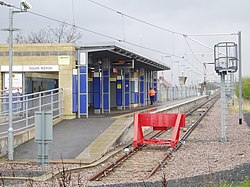
South Hylton Metro station
South Hylton is a Tyne and Wear Metro station, serving the suburbs of Pennywell and South Hylton, City of Sunderland in Tyne and Wear, North East England. It joined the network as a terminus station on 31 March 2002, following the opening of the extension from Pelaw to South Hylton.

751 m
South Hylton
South Hylton () is a suburb of Sunderland, Tyne and Wear, England. Lying west of Sunderland city centre on the south bank of the River Wear, South Hylton has a population of 10,317 (2001 Census). Once a small industrial village, South Hylton (with only one access road) is now a dormitory village and is a single track terminus for the Tyne and Wear Metro.
South Hylton was originally known as Hylton Ferry or Low Ford, its current name not coming into regular use until the late 18th to early 19th century. It originally formed part of the Manor of Ford owned by the Barons Hylton, until the estates of Hylton Castle were sold off in 1750 after the death of the last baron. Originally a collection of farmsteads, it became a diversified industrial village as a result of the Industrial Revolution.