Trafford Waters is a major mixed-use development, currently under construction in Trafford, Greater Manchester on land between the Manchester Ship Canal and the Trafford Centre. The land is owned and will be developed by Peel Land & Property. The development is proposed to take place in six phases over 15 years, with the first phase being completed by 2017–18. The area would be served by the proposed Trafford Quays Metrolink station. The proposal includes 3,000 homes, areas for employment, a primary school, retail and community facilities. Planning permission was granted in October 2016. The Trafford Waters masterplan received outline planning permission from Trafford Council in 2018 and planning permission for the infrastructure works was subsequently received. Construction started on the first 350 homes in October 2022.

Nearby Places View Menu
215 m

Dumplington

Dumplington is an area of Trafford, Greater Manchester, England. Dumplington was one of several hamlets in the township of Barton-upon-Irwell, in the ancient ecclesiastical parish of Eccles in the hundred of Salford. Its name derives from the Old English dympel and ing and tun which means an enclosure by a pool. The hamlet lies six miles south west of Manchester city centre. Dumplington was recorded in the Middle Ages in 1225 in land leases between Sir Robert Grelley and Cecily, daughter of Iorwerth de Hulton and Siegrith de Dumplington. John son of Thomas de Booth was the landowner in 1401. The Roman Catholic church of All Saints is a Grade II* listed building, designed in 1867-8 by Edward Welby Pugin. Since the late 1990s, there has been significant redevelopment in this area including the Trafford Centre, Trafford Waters and the extension of the Metrolink line.
Location Image
359 m

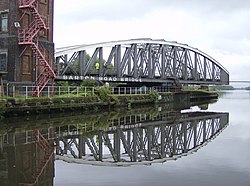
Barton Road Swing Bridge

Barton Road Swing Bridge (or Barton Road Bridge) is a swing bridge for road traffic in Greater Manchester that crosses the Manchester Ship Canal between Trafford Park in the Metropolitan Borough of Trafford to Barton-upon-Irwell in the City of Salford. The bridge is a Grade II* listed building, and is part of a surrounding conservation area. It runs parallel to the Barton Swing Aqueduct which carries the Bridgewater Canal. The bridge opens regularly for traffic along the Manchester Ship Canal, which can cause delays for road traffic. The bridge and aqueduct were inaugurated along with the Manchester Ship Canal in 1894, though a bridge had previously existed at this location for over 200 years. During the 20th century, it became increasingly important as an access route to Trafford Park and to allow traffic to bypass Manchester and Salford city centres, and consequently became a significant traffic bottleneck. A replacement high level bridge was built further downstream, and today the swing bridge carries mostly local traffic.
Location Image
415 m

Barton Aqueduct

The Barton Aqueduct, opened on 17 July 1761, carried the Bridgewater Canal over the River Irwell at Barton-upon-Irwell, in the historic county of Lancashire, England. Designed largely by James Brindley under the direction of John Gilbert, it was the first navigable aqueduct to be built in England, "one of the seven wonders of the canal age" according to industrial archaeologist Mike Nevell. Construction proceeded quickly, but disaster almost struck when the aqueduct was first filled with water and one of its three arches began to buckle under the weight. Remedial work took several months, but the aqueduct was still opened to traffic only 15 months after the enabling Act of Parliament had been passed, on 17 July 1761. It remained in use for more than 100 years, until the construction of the Manchester Ship Canal necessitated its demolition in 1893, replaced by the Barton Swing Aqueduct.
424 m

Barton Power Station

Barton Power Station was a coal-fired power station on the Bridgewater Canal in Trafford Park, near Eccles, Lancashire, England.