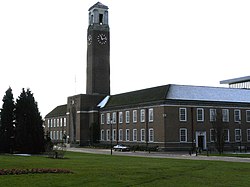
Pendlebury Colliery

Pendlebury Colliery, usually called Wheatsheaf Colliery after the adjacent public house, was a coal mine operating on the Manchester Coalfield after 1846 in Pendlebury near Manchester, then in the historic county of Lancashire, England. The colliery, sunk in 1846, was owned by Andrew Knowles and Sons and had two ten foot diameter shafts 24 yards apart.> The colliery originally had pitch pine timber headgear and a winding engine supplied by John Musgrave & Sons of Bolton that operated until 1944. The colliery was ventilated by furnace until the 20th century when ventilation fans were installed. Wrought iron boilers to raise steam for powering pumps, air compressors and haulage were originally sited near the bottom of No.2 shaft, the upcast shaft. The shaft bottom was reached at 1,775 feet. The colliery accessed several coal seams including the Rams, Crumbouke and Doe mines. In 1896 the colliery employed 640 men underground and 165 surface workers while in 1923 there were 563 underground and 172 surface workers. The colliery became part of Manchester Collieries in 1929 and the National Coal Board in 1947. The colliery was connected by tunnel to Newtown Colliery in 1957 but closed in June 1961. The colliery was situated on the north-east side of Bolton Road (A666), Pendlebury between Carrington Street and City Walk on what is now the Wheatsheaf Industrial Estate.

Nearby Places View Menu
Location Image
374 m

Pendlebury railway station

Pendlebury railway station was a station serving the town of Pendlebury in the City of Salford, Greater Manchester, England. It was closed in 1960 by British Railways.
Location Image
405 m

St Augustine's Church, Pendlebury

St. Augustine's Church is an active Anglican church in Pendlebury, Greater Manchester, England. Dedicated to St Augustine, it is part of the benefice of Swinton and Pendlebury along with St Peter's Church in Swinton and All Saints' Church in Wardley. The church is in the Eccles deanery, the archdeaconry of Salford and the diocese of Manchester. The church was granted Grade II* listed status in 1966 but has since been upgraded to Grade I. Called the "Miners' Cathedral", due to its almost cathedralesque stature, in the heart of a one time coal-mining community, it was also sometimes locally called "Gussie's". The church is situated on Bolton Road and has a connected primary school.
Location Image
554 m

Municipal Borough of Swinton and Pendlebury
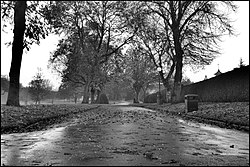
Swinton and Pendlebury was a local government district of the administrative county of Lancashire, England. It was created in 1894 as an urban district and enlarged in 1934, gaining the status of a municipal borough. Before the new town hall was built to accommodate the new municipal borough in the 1930s, the urban district was governed from Pendlebury Town Hall on Bolton Road at the junction with Carrington Street. This building eventually became the town's main public library and was used as such until a new library was opened within the newly built Lancastrian Hall on Chorley Road, Swinton at the junction with Station Road (B5231).
Location Image
580 m

Victoria Park, Swinton

Victoria Park is a park in Swinton, Greater Manchester. Situated on Manchester Road (A6), Swinton, it opened as a public park in 1897. Victoria Park is made up of the grounds of Swinton Old Hall; the hall itself being demolished in 1993. Having tennis courts and two bowling greens, Victoria Park is home to a Grade II listed Victorian bandstand built to commemorate the 60th year of the reign of Queen Victoria; the bandstand being built around 1897. Swinton and Pendlebury received its Charter of Incorporation as a municipal borough from Edward Stanley, 18th Earl of Derby at a ceremony in Victoria Park on 29 September 1934. Victoria Park has been awarded three Green Flag Awards. The Green Flag Scheme is a national standard for public parks and green spaces that aims to raise standards across the UK. This award puts Victoria Park alongside Brighton Pier, London Zoo, Alton Towers and the Norfolk Broads.