
Location Image

Rue Édouard-Delesalle

La rue Édouard Delesalle est une rue de Lille.

1. Situation et accès

Située dans le quartier Lille-Centre, elle relie la rue du Molinel à la rue de la Vignette (place Gentil-Muiron) dans l’ancienne paroisse Saint-Sauveur.

1. Origine du nom

Son nom est celui d’un adjoint au Maire de Lille, fondateur en 1889 du quotidien Le Réveil du Nord. Ce journal socialiste au cours de sa première période, de gauche moins radicale après 1900, sombra dans la collaboration et ses biens furent attribués à Nord Matin à la Libération.

1. Historique

La rue est ouverte en 1926 en grande partie sur les terrains d'un ancienne manufacture de salpêtre. Cette fabrique de poudres fut installée dans les bâtiments du couvent des Capucins fermé sous la Révolution et affecté le 7 pluviôse de l’an II à « l’administration des poudres et salpêtres». Cette manufacture reconstruite en 1861 fut en activité jusqu’en 1914. Le couvent des Capucins construit de 1593 à 1594 aux frais du magistrat (la Ville de Lille) pour les frères mineurs Capucins qui venaient de s’établir à Lille en 1592 fait partie des fondations religieuses établies à cette époque à Lille dans le cadre de la Contre-Réforme. Les jardins du couvent s’étendaient jusqu’au canal des Hibernois à la place du rempart démoli de 1603 à 1606 lors de l’agrandissement de Lille au sud-ouest de l’ancienne porte du Molinel. La rue absorbe l’ancienne rue des Capucins qui donnait accès à ce couvent à partir de la rue du Molinel et, à l’autre extrémité, le bâtiment de l’ancien collège des Hibernois qui était situé à l’angle de la rue de la Vignette et du canal des Hibernois. Le souvenir de cette rue et de l'ancien couvent est rappelé par une plaque à l'entrée de la rue.

1. Bâtiments remarquables et lieux de mémoire

Médiathèque Jean-Lévy construite de 1960 à 1964. Bibliothèque municipale principale de Lille. Immeuble de la mutualité meunière à l'angle de la rue de la Vignette construit vers 1925 pour une société coopérative.

1. Références


1. Voir aussi


1. = Articles connexes =

Liste des rues de Lille Portail de l’architecture et de l’urbanisme Portail de la métropole européenne de Lille

Nearby Places View Menu
Location Image
114 m

Siege of Lille (1940)

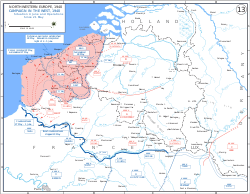
The siege of Lille or Lille pocket (28–31 May 1940) took place during the Battle of France in the Second World War. The siege of the French IV Corps and V Corps (about 40,000 men) of the First Army (General René Prioux) was conducted by four German infantry divisions supported by three panzer divisions. The III Corps of the First Army had managed to retreat to the Lys river with the British Expeditionary Force (BEF) divisions nearby. The two surrounded French corps resisted German attacks until forced to surrender at midnight on 31 May/1 June. The defence of the Lille Pocket enabled more Allied troops to retreat into the Dunkirk perimeter and take part in the Battle of Dunkirk.
Location Image
242 m

Christ Church, Lille

Christ Church Lille is an English-speaking Anglican Church located in the city of Lille in Nord-Pas-de-Calais, the Flemish area of France. Christ Church Lille is part of the Church of England, Diocese in Europe.
Location Image
319 m

Palais des Beaux-Arts de Lille

The Palais des Beaux-Arts de Lille (Lille Palace of Fine Arts) is a municipal museum dedicated to fine arts, modern art, and antiquities located in Lille. It is one of the largest art museums in France. It was one of the first museums built in France, established under the instructions of Napoleon I at the beginning of the 19th century as part of the popularisation of art. Jean-Antoine Chaptal's decree of 1801 selected fifteen French cities (among them Lille) to receive the works seized from churches and from the European territories occupied by the armies of Revolutionary France. The painters Louis Joseph Watteau and François-Louis-Joseph Watteau, known as the "Watteau of Lille", were heavily involved in the museum's beginnings - Louis Joseph Watteau made in 1795 the first inventory of the paintings confiscated during the Revolution, whilst his son François was deputy curator of the museum from 1808 to 1823. The museum opened in 1809 and was initially housed in a church confiscated from the Récollets before being transferred to the city's town hall. In 1866, the "musée Wicar", formed from the collection of Jean-Baptiste Wicar, was merged into the Palais des Beaux-Arts. Construction of the Palais's current Baroque-revival-style building began in 1885 under the direction of Géry Legrand, mayor of Lille, and it was completed in 1892. The architects chosen to design the new building were Edouard Bérard (1843–1912) and Fernand Etienne-Charles Delmas (1852–1933) from Paris. During the early 20th century, Victor Mollet served as its official architect. The building is located on the place de la République, in the center of the city, facing the préfecture of Lille. It was renovated during the 1990s and reopened in 1997. At the start of the 1990s, the building's poor state and the moving of Vauban's relief models of fortified towns to Lille forced the town to renovate the building. Work began in 1991, under the architects Jean-Marc Ibos and Myrto Vitart, and was completed in 1997. This allowed the creation of a new 700 m2 basement room for temporary exhibitions, as well as departments for the relief models and for 19th-century sculpture. Overall the museum covers 22000 m2 and held 72430 pieces as of 2015, one of the largest provincial collections of fine art. The collection includes works by Raphael, Donatello, Van Dyck, Tissot, Jordaens, Goya, El Greco, David, Corot, Courbet, Toulouse-Lautrec, Delacroix, Rubens, Rodin, Claudel and Jean Siméon Chardin.
380 m

Canton of Lille-4

The canton of Lille-4 is an administrative division of the Nord department, northern France. It was created at the French canton reorganisation which came into effect in March 2015. Its seat is in Lille. It consists of the following communes: Lezennes Lille (partly) Ronchin
Location Image
388 m

Saint-Maurice, Lille

The Église Saint-Maurice is a church on Rue Pierre-Mauroy, in the historic centre of Lille, northern France. Its construction began at the end of the 14th century and completed at the end of the 19th century, and it was extended over more than four centuries. A hall church in the Gothic style, it was made a monument historique in 1914.