

 English
 Français
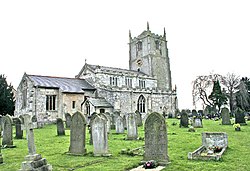
Wistow (Yorkshire du Nord)
Wistow est un village et une paroisse civile du Yorkshire du Nord, en Angleterre. Il est situé dans le sud du comté, à environ quatre kilomètres au nord de la ville de Selby. Au moment du recensement de 2011, il comptait 1 333 habitants et au recensement de 2021, elle comptait 1 335 habitants. L'église du village est un monument classé de Grade I.
1. Toponymie
Wistow dérive du vieil anglais wīc-stōw « lieu d'habitation ». Ce nom est attesté vers 1030 sous la forme Wicstow.
1. Références


1. Liens externes
Portail du Yorkshire
Nearby Places View Menu

0 m
Wistow, North Yorkshire
Wistow is a small village and civil parish just north of Selby, North Yorkshire, England. In the 2011 Census it had 1,333 residents; an increase from 2001 when there was 1,135.
It was historically part of the West Riding of Yorkshire until 1974. From 1974 to 2023 it was part of the district of Selby. It is now administered by the unitary North Yorkshire Council.
51 m
All Saints' Church, Wistow
All Saints' Church is the parish church of Wistow, a village north-west of Selby in North Yorkshire, in England.
There has been a church on the site since at least the 12th century, but the oldest surviving parts of the current church are 13th century. It was altered in the 14th and 15th centuries, and then in the 16th century, the chancel was rebuilt and a tower was added. From 1883 to 1884, it was restored by James Demaine, who added a vestry and organ chamber, while the stained glass windows were restored by J. W. Knowles. In 1900, C. Hodgson Fowler installed a new floor, and in 1911 Walter Brierley repaired the reredos and panelling. The church was Grade I listed in 1966.
The church is built of Magnesian Limestone, with a roof of tiles and Welsh slate. 13th century features include the south arcade, west door, and lancet windows to the nave, some of which contain mediaeval glass. The east window is 14th century, with five lights, while the other windows in the chancel are 15th century and flat headed. The tower has three stages, and is in the Perpendicular style. Inside, there is an 18th-century memorial with a carved death's head and painted shield.
526 m
Wistow railway station
Wistow was the sole intermediate station of the short Cawood, Wistow and Selby Light Railway (CW&SLR), in rural North Yorkshire, England. The line was connected to the North Eastern Railway (NER) at its southern end.

2.5 km
The Grange, Cawood
The Grange is a historic building in Cawood, a village in North Yorkshire, in England.
The building was constructed in the 16th century, for the Nicholson family, who held offices under the Archbishop of York. It was rebuilt in the mid-17th century, and was altered in the 18th century, and again around 1900. As part of these last changes, the original roof was replaced. Around this time, four life-sized Mediaeval sculptures believed to represent the Four Evangelists were found buried at All Saints' Church, Cawood, and were put on display outside the house. They were later passed to the owner of Cawood Castle, and two are now in the Yorkshire Museum. The house was Grade II* listed in 1966.
The house is partly timber framed, with the rest in orange-red brick, with floor bands, a dentilled moulded cornice, a pantile roof with brick-capped kneelers and gable ends, and a curvilinear gable on the rear wing. It has two storeys and an L-shaped plan, with a front range of three bays, a rear wing, and two outshuts. On the front is a two-storey pedimented porch with an elliptical entrance, side seats inside, and an internal doorway. The windows on the front are sashes with alternate proud and flush voussoirs, and elsewhere there are mullioned windows. Inside, there is 17th-century panelling in the hall, with a 20th-century frieze, and original 17th-century panelling in a room to its right. There are also some early panelled doors.

2.6 km
Yew Tree House
Yew Tree House is a historic building in Cawood, a village in North Yorkshire, in England.
The house was originally built in the mid to late 17th century. Stables were added in the 18th century, and in the 19th century a two-storey block was added, linking the house to the stables. There were further additions in the 20th century, and the property was divided into two houses. The entire building was Grade II* listed in 1966.
The house is built of brick with stone dressings, floor bands, and a pantile roof with Dutch gables. It has two storeys and an attic, a front of three bays, and at the rear is a stair tower, and two two-storey outshuts, one linking with the two-storey three-bay former stable block. On the front is a two-storey porch with a moulded pediment, containing a segmental-arched entrance. The windows on the front are sashes, some horizontally-sliding. In the left gable end is a blocked mullioned window. Inside, there are moulded beams in some ground floor rooms, and some also have early sliding shutters.