

 English
 Français
Mechouar Kasba
Mechouar Kasba (Arabic: المشور القصبة,) is a town and municipality in Marrakesh Prefecture of the Marrakesh-Safi region of Morocco. At the time of the 2014 census, the commune had a total population of 16,860 people.
1. References
Nearby Places View Menu

294 m
Dar Si Said
Dar Si Said (Arabic: دار السي سعيد) is a historic late 19th-century palace and present-day museum in Marrakesh, Morocco. It currently houses the National Museum of Weaving and Carpets.
346 m
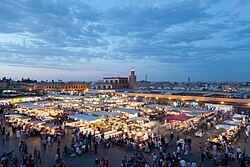
Jemaa el-Fnaa
Jemaa el-Fnaa (Arabic: ساحة جامع الفناء, romanized: Sāḥat Jāmiʾ al-Fanā), also Jemaa el-Fna, Djema el-Fna or Djemaa el-Fnaa, is a square and market place in the medina quarter (old city) of Marrakesh, Morocco. It remains the main square of Marrakesh, used by locals and tourists.

374 m
2011 Marrakesh bombing
The 2011 Marrakesh bombing was a domestic terrorist bombing of the Argana Cafe in Jemaa el-Fnaa, Marrakesh, Morocco, on April 28, 2011. A lone terrorist, Adil El-Atmani, planted two homemade pressure cooker bombs hidden inside of a backpack at the cafe and detonated them at 11:50 a.m., killing 17 and injuring 25. Many of the dead were tourists, including a group of French students.
El-Atmani, a 25 year-old shoe salesman, pledged allegiance to Al-Qaeda in the Islamic Maghreb, who denied involvement in the attack. He was arrested six days later after a SIM card registered under his name was found in what remained of the bomb. During questioning, he said that he learned bomb-making on the Internet. A letter to the French government found on his laptop ordered the withdrawal of French troops in the Middle East, threatening to "attack targets in the heart of France" if his order was not fulfilled within the twenty days following the attack.
Adil El-Atmani was sentenced to death for the attack by an anti-terrorism court in Salé. He is awaiting execution at Moul El Bergui central prison in Safi. He was put in solitary confinement in 2017 after attempting to kill his cellmate.
495 m
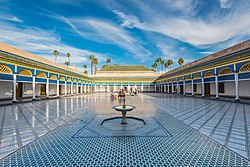
Bahia Palace
The Bahia Palace (Arabic: قصر الباهية) is a mid to late 19th-century palace in Marrakesh, Morocco. The palace was first begun by Si Musa, grand vizier under the Alawi sultan Muhammad ibn Abd al-Rahman, in the 1860s. It was expanded by his son Si Ba Ahmed ibn Musa, grand vizier of Sultan Moulay Abdelaziz, between 1894 and 1900. Today it is a well-known historic monument and tourist attraction in the city.
The palace has an irregular layout comprising around 150 rooms organized around multiple internal courtyards and riad gardens. It is most notable for its decoration, particularly its painted wood ceilings, along with sculpted stucco and zellij tilework. The original grounds of the palace also encompassed a wider area with gardens, parks, stables, a mosque, and other annexes.