The Bay Bridge Troll is an 18-inch steel figure that was welded to the eastern span of the original San Francisco Bay Bridge. It was replaced by a newer version in 2013 once the construction of the new Bay Bridge was complete. The creator of the original troll, Bill Roan, is a blacksmith turned artist who lived near the Bay Bridge.

1. History

In 1989, a section of the Bay Bridge collapsed during the Loma-Prieta earthquake that rocked the San Francisco Bay Area. The bridge was closed for several weeks while repairs were made. When the repairs to the bridge were nearly complete, ironworkers smuggled the small metal troll onto the bridge and welded it permanently to a steel beam on the north side of the bridge. This unusual topping out ceremony became the subject of much curiosity and rumor around the Bay Area. John V. Robinson cites the Bay Bridge troll as an example of a custom being adapted to an unusual circumstance. The troll first came to the public's attention on January 15, 1990, when the San Francisco Chronicle ran a story about the small figure of a troll complete with a spud wrench that had been welded to the iron below the road on the north side of the bridge. The article quotes official spokesman for the state Department of Transportation, Greg Bayol, as saying, "If we were asked, we would have said 'no,' I'm sure." The iron workers had never asked to put the troll on the bridge, so the state is stuck with the troll. The troll was placed where motorists on the bridge would never see it. It was on the north side of the outside rail, where only maintenance workers and ironworkers ever venture. When the troll was made, the contractor, Rigging International, ordered another, now mounted on a damaged section of the old bridge on display in the lobby of their Alameda office. In August 2013, a white paper was published to the Bay Bridge's website, advocating the troll and the entire section of the span on which it resides be preserved. In 2002, a new eastern span of the Bay Bridge began construction. The new span opened on Labor Day 2013, and the troll was removed from the old span by ironworkers two days prior on August 30. The troll was on display at the Oakland Museum of California from November 6, 2013, through February 26, 2014. During this time Caltrans considered whether to retire the troll to a museum or attach it to the tower of the new bridge. On December 23, 2013, an article in SFGate stated that a new, sleeker troll carrying a sledgehammer had been created. The article suggested that the new troll was either living temporarily in a secret location or was already installed on the new bridge.

On May 13, 2014, an article on SFGate Blog announced that the new troll has officially been placed on the eastern span of the Bay Bridge. It was said to have been installed overnight, as it is averse to sunlight. "The new troll emerged from hiding Friday and quietly moved in, settling on Pier E2." The troll was placed below the roadway out of sight of motorists; however, it can be seen from a pedestrian walkway. In March 2018 John V. Robinson published a book titled The Oakland-San Francisco Bay Bridge Troll which documents the creation and removal of the old troll as well as the creation of the new troll on the new Bay Bridge.

1. See also

Builders' rites YouTube video showing new location of the troll

1. References


1. External links

Photograph of Twin Troll Photograph of 2013 New Troll Reprint of the Nolte article

Nearby Places View Menu
Location Image
647 m

Palace of Fine and Decorative Arts

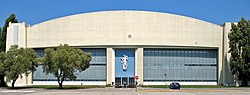
The Palace of Fine and Decorative Arts, also known as Building 3, on Treasure Island in San Francisco Bay, California, was an aircraft hangar constructed in 1938 for Pan American World Airways' trans-Pacific Clipper services, and then modified for the 1939-40 Golden Gate International Exposition. Building 3 was one of a pair of identical hangars built to house Pan American's flying boats at the south end of the island. Building 1 was to be the airline's terminal building, and Buildings 2 and 3 would house the aircraft. For the exposition, these buildings were converted to exhibition halls, surrounded by a complex of temporary structures. At the end of the exposition all structures but Buildings 1, 2 and 3 were to be torn down to make way for the development of the reclaimed land as an airport for San Francisco.
Location Image
731 m

Hall of Transportation, Treasure Island

The Hall of Transportation, Treasure Island, on Treasure Island, California, also known as Building 2, was built in 1938 for the 1939-40 Golden Gate International Exposition. It served as the hall of transportation for the exposition. It was constructed with the idea that it would serve as an airplane hangar after the Exposition but it never did. It was designed in Moderne style by architects William Peyton Day and George William Kelham. It was listed on the National Register of Historic Places in 2008.
Location Image
734 m

Yerba Buena Island

Yerba Buena Island (Spanish: Isla Yerba Buena) sits in San Francisco Bay within the borders of the City and County of San Francisco. The Yerba Buena Tunnel runs through its center and connects the western and eastern spans of the San Francisco–Oakland Bay Bridge, linking the city with Oakland, California. Treasure Island is connected by a causeway to Yerba Buena Island. According to the United States Census Bureau, Yerba Buena Island and Treasure Island together have a land area of 0.901 square miles (2.33 km2) with a total population of 2,500 as of the 2010 census. Yerba Buena Island has had several other names over the decades: Sea Bird Island, Wood Island, and Goat Island. The island may have been named after the pueblo of Yerba Buena, which was named for the plant of the same name that was abundant in the area. The plant's English and Spanish common name, Yerba buena, is an alternate form of the Spanish hierba buena (literally meaning 'good herb'), generally used to describe local species of the mint family. Today, the military reservation southeast of the Yerba Buena Tunnel belongs to the United States Coast Guard (USCG) District Eleven. The US Coast Guard Sector San Francisco – Vessel Traffic Service (VTS) tower is located on Signal Road Building 278 atop the peak of the island. The US Coast Guard Sector San Francisco Headquarters is co-located with US Coast Guard Station San Francisco on Healy Avenue and Fresnel Way at water-level on the southeast coast of the island. The Coast Guard Aids to Navigation San Francisco has a navigational buoy repair facility on Fresnel Way. The USCG Senior Officers' residences are in Quarters A, B, C, 8 and 9 off of Hillcrest Road on the hill atop the USCG base. During the summer of 2011, the Department of Homeland Security / United States Coast Guard opened the new SAFE Port Act (2006) Interagency Operations Center (IOC at Building 100 site on Spindrift Circle) on the US Coast Guard Sector / Station San Francisco base. The IOC houses the VTS, WatchKeeper and the US Coast Guard Sector San Francisco Command Center together in one building.
Location Image
746 m

Yerba Buena Tunnel

The Yerba Buena Tunnel, also known as the Yerba Buena Island Tunnel, is a highway tunnel in San Francisco, California. It is the part of San Francisco–Oakland Bay Bridge complex that crosses Yerba Buena Island. The Yerba Buena Tunnel carries ten lanes of Interstate 80 (I-80) on two decks, connecting the two component spans of the Bay Bridge, the western suspension span and the eastern self-anchored suspension span. At the opening of the Bay Bridge in 1936, it was the world's largest-bore tunnel.