

 English
 Français

Horncliffe
Horncliffe est une paroisse civile et un village du Northumberland, en Angleterre. La population de la paroisse civile au recensement de 2011 était de 403 habitants.
1. Notes et références
(en) Cet article est partiellement ou en totalité issu de l’article de Wikipédia en anglais intitulé « Horncliffe » (voir la liste des auteurs).
1. Liens externes
Portail de l’Angleterre
Nearby Places View Menu
0 m
Horncliffe
Horncliffe is a village in the county of Northumberland, England. It lies on the south bank of the River Tweed about 5 miles (8 km) southwest of Berwick-upon-Tweed, and about 3 miles (5 km) northeast of Norham and is the most northerly village in England.
1.7 km
Union Chain Bridge
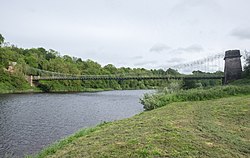
The Union Chain Bridge or Union Bridge is a suspension bridge that spans the River Tweed between Horncliffe, Northumberland, England and Fishwick, Berwickshire, Scotland. It is four miles (6.4 km) upstream of Berwick-upon-Tweed.
When it opened in 1820 it was the longest wrought iron suspension bridge in the world with a span of 449 feet (137 m), and the first vehicular bridge of its type in the United Kingdom. Although work started on the Menai Suspension Bridge earlier, the Union Bridge was completed first. The suspension bridge, which is a Category A listed building in Scotland, is now the oldest to be still carrying road traffic.
The bridge is also a Grade I listed building in England and an International Historic Civil Engineering Landmark. It lies on Sustrans Route 1 and the Pennine Cycleway. Its chains are represented on the Flag of Berwickshire.
1.8 km
Fishwick, Scottish Borders
Fishwick is a parish with a small mediaeval village (now vanished) in the Scottish Borders, Scotland, in the traditional county of Berwickshire, seven miles from Berwick-upon-Tweed. The parish church is now a ruin and the parish is united with Hutton and Paxton. Today the parish consists of farms and scattered housing. There is also an old WWII airstrip, still occasionally used. Fishwick borders the north of the River Tweed which here constitutes the border with England.
Anciently Fishwick was a possession of Coldingham Priory a cell of the Bishopric of Durham. The superiorities of the Priory became part of the Barony of Coldingham which in 1621 was held by James, 2nd Earl of Home (d. 1633). A William Purves was a resident in Fishwick in Nov 1577 when he witnessed a Sasine.
Just south of the Tweed from Fishwick is the northernmost village in England, Horncliffe. Between Fishwick and Horncliffe is the famous Union Bridge, a very early suspension bridge dating from 1820. When it was opened it was the longest wrought-iron suspension bridge in the world, and it is still carrying traffic, though now only one vehicle at a time. One of the toll cottages was demolished in 1955. The crossing is now toll-free.
1.9 km
Velvet Hall railway station
Velvet Hall railway station was a railway station which served the village of Horncliffe in Northumberland, England.

2.6 km
Paxton House, Berwickshire
Paxton House is a historic house at Paxton, Berwickshire, in the Scottish Borders, a few miles south-west of Berwick-upon-Tweed, overlooking the River Tweed.
It is a country house built for Patrick Home of Billie in an unsuccessful attempt to woo a Prussian heiress, Sophie de Brandt. Attributed to James Adam (possibly in concert with John Adam), it was built between 1758 and 1766, under the supervision of James Nisbet, with extensive interiors (c1773) by Robert Adam, as well as furniture by Thomas Chippendale. The East Wing was added in 1812-13 by architect Robert Reid to house the library and picture gallery.
Other inhabitants were Alexander Home and his son George Home (of Wedderburn and Paxton).
In 1852 Jean Milne, the wife of David Milne, inherited the house and he renamed himself David Milne-Home.
Formerly the seat of the Paxton family, who became Forman-Home, Milne-Home, and finally Home-Robertson as the direct male lines failed and the inheritance progressed through a female. In 1988, the last laird, John David Home Robertson, a Labour member of Parliament, placed the house and grounds into the Paxton House Historic Building Preservation Trust. It is now open to the public and is a Partner Gallery of National Galleries Scotland.